

Bottom line first: on 10 October 2026, KULUN Electric commissioned a 29.7MW pipeline air heating system in Sichuan, using multiple APR3L-1200V-1000A medium-voltage power control cabinets. Each cabinet is rated 1200 V output voltage and 1000 A output current, for a three-phase capacity of about 2.08 MW, and handles continuous power regulation and temperature closed-loop control for its section of the air heater. This article covers the system role on site, why the 1200 V class was chosen, the items to check before and after commissioning a multi-unit installation, and the selection points for similar duties.
Pipeline air heating has one defining feature: the heated medium is moving air. Thermal inertia is small, the load follows the flow rate, and the power must be continuously adjustable. The 29.7MW total is shared across multiple APR3L-1200V-1000A cabinets, each regulating its own section of heating elements. That rules out on/off switching in favour of controllers that track the process - when flow or target temperature changes, output power follows smoothly, without temperature overshoot or current inrush. Phase-angle fired thyristor control answers exactly this requirement, which is why power control cabinets were selected here rather than a contactor-based on/off scheme.
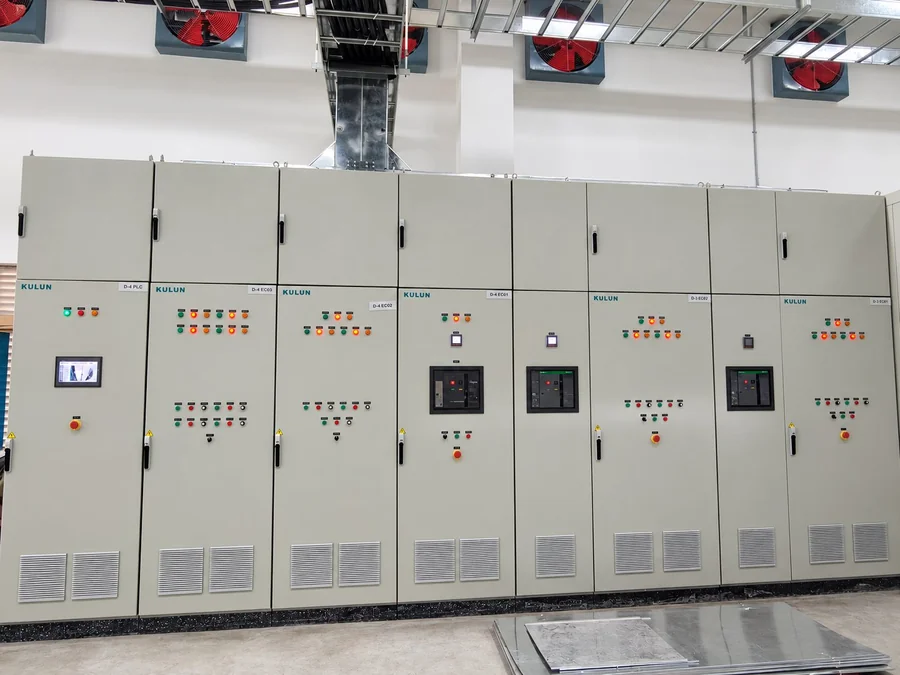
What does the system do on this site?
In the 29.7MW pipeline air heating system, multiple APR3L-1200V-1000A cabinets operate in parallel, each performing three functions. First, it delivers grid power to its section of heating elements at a continuously regulated level, adjustable across the 0-100% range. Second, it accepts the setpoint and control signal from the temperature controller or PLC and holds the corresponding air outlet temperature near the process target. Third, it limits or interrupts output on overcurrent, phase loss or overtemperature, protecting both the local heating elements and the internal semiconductors without affecting adjacent units.
Why consider a 1200 V class at this power level?
The 29.7MW total is shared across multiple APR3L-1200V-1000A cabinets, each about 2.08 MW. Voltage class is not specified first and matched to a cabinet afterwards - it is derived from the per-cabinet power and current together. From P = √3 × U × I, the same 2.08 MW heater draws roughly 3000 A at 400 V and roughly 1000 A at 1200 V (√3 × 1200 V × 1000 A ≈ 2078 kW, matching the per-cabinet rating). Cutting current to about one third changes three things at once: less copper in the incoming cable and busbar, lower line loss, and less thermal stress on the internal joints and thyristors.
The reverse also holds - higher is not automatically better. Raising the voltage increases the number of series-connected thyristors and the voltage margin required, the insulation and creepage distances, and the enclosure and operational safety requirements. The engineering sequence is therefore: fix the class from the existing site busbar, and only step up when the current makes a low-voltage design clearly uneconomic. 1200 V sits on the boundary between low and high voltage and is commonly called medium voltage in the industry.
Key ratings of the APR3L-1200V-1000A
| Item | Value | Note |
|---|---|---|
| Model | APR3L-1200V-1000A | Medium-voltage power control cabinet |
| Rated output voltage | 1200 V | Set by the site busbar and load power |
| Rated output current | 1000 A | From load power and duty cycle |
| Phases | Three-phase | Matches the site supply |
| Rated capacity per cabinet | Approx. 2.08 MW | √3 × 1200 V × 1000 A |
| System total power | 29.7 MW | Multiple APR3L-1200V-1000A cabinets in parallel |
| Duty | Pipeline air heating | Moving air; load follows flow |
| Commissioned | 10 October 2026 | After site commissioning |
| Location | Sichuan, China | Customer name withheld by agreement |
What to check when selecting for a similar duty
| Check item | Basis | Common mistake |
|---|---|---|
| Supply voltage class and frequency | Fixed by the existing site busbar, not by the cabinet | Specifying the preferred value and finding a mismatch on delivery |
| Rated output current per cabinet | Calculated from load power and duty cycle, with margin | Sizing from cold-state or hot-state resistance only, undersizing the result |
| System total power and number of cabinets | Derived from total process load and per-cabinet capacity | Mismatch between total power and per-cabinet capacity |
| Load resistance behaviour | Difference between cold and hot resistance of the elements | Ignoring cold-start inrush, overloading during start-up |
| Control mode | Constant voltage, current or power, chosen against the process target | Specifying open-loop manual control where the process needs a temperature loop |
| Control signal and interface | 4-20 mA / 0-10 V or a bus, matched to the host system | Interface form differs from the PLC side, requiring rework on site |
| Cooling method | From internal heat loss and site ventilation | Counting device losses only, ignoring ducting and inlet air temperature |
| Protection and insulation | From voltage class and site safety rules | Applying low-voltage cabinet practice to a medium-voltage design |
| Multi-unit parallel operation | Setpoint, feedback and limit values must be consistent | Tuning each cabinet independently, causing unequal output or overload |
How is commissioning sequenced on site?
Commissioning of the 29.7MW system normally follows this order: delivery inspection and visual check, insulation resistance and withstand test, individual no-load energisation and firing waveform check of each cabinet, multi-unit coordination and power-sharing verification, on-load heat-up with voltage and current records, closed-loop parameter tuning, then a continuous run assessment. Every step is documented, and the next step does not start until the previous one passes.
Multi-unit coordination and closed-loop tuning are the two steps with the largest effect on the process. Multiple APR3L-1200V-1000A cabinets in parallel need consistent setpoint, feedback and limit settings to avoid one unit overloading or producing unequal output. Because the load follows air flow, the proportional and integral terms must be tuned across the actual flow range rather than copied from another furnace type; after tuning, verify at least one operating point in each commonly used flow band and confirm the temperature swing stays inside the process window.
FAQ
Q: Is 1200 V medium voltage or high voltage?
A: In common Chinese practice, AC up to and including 1 kV is classed as low voltage and anything above 1 kV falls into the high-voltage category, with the lower part of that range usually called medium voltage. The 1200 V of the APR3L-1200V-1000A sits on the boundary. For selection purposes the name matters less than three checks: the actual site busbar voltage, the insulation level required, and the applicable operational safety rules.
Q: Why is the 29.7MW system built from multiple cabinets instead of one large cabinet?
A: A single 29.7MW unit would push engineering difficulty and cost up sharply because of thyristor paralleling, current capacity, enclosure size, transport limits and maintenance access. Splitting the load into multiple 2.08MW-class cabinets gives independent control and protection for each unit, so maintenance on one cabinet does not stop the others and power can be zoned or staged.
Q: Why not use contactor on/off control for pipeline air heating?
A: Because the heated medium is moving air with low thermal inertia. On/off control makes temperature oscillate around the setpoint and imposes a current inrush at every switch-on. A phase-angle fired thyristor cabinet regulates output continuously, follows changes in flow and temperature smoothly, keeps the temperature band narrower, and reduces thermal shock on the heating elements.
Q: Is a 400 V design not workable for a 2 MW air heater?
A: It is technically possible, but the cost is current. From P = √3 × U × I, 2.08 MW draws about 3000 A at 400 V and about 1000 A at 1200 V - roughly a threefold difference, with copper in cable and busbar, line loss and internal thermal stress rising in step. Whether to step up the voltage class should be decided by comparing first cost against long-term loss, not by the price of the cabinet alone.
Q: What data is needed to enquire about a medium-voltage power control cabinet?
A: At least seven items: supply voltage class and frequency, rated output voltage and current, load type and resistance behaviour, control mode, cooling method, protection and insulation requirements, and control/communication interface. With these fixed, the cabinet design and lead time can be quoted accurately; missing items force a quote on assumed conditions and leave a lot of room for later change.
Q: Can an existing cabinet be replaced directly during a retrofit?
A: Direct replacement is not recommended. Check four things first: whether the existing output voltage and current cover the new load, whether the control signal form matches the existing host system, whether enclosure size and cable entry match the site foundation, and whether the site busbar voltage still matches the original design. Only after all four are confirmed should you decide between a full cabinet replacement and a control-section retrofit.
Timeliness note
This article reflects project commissioning information from Sichuan Kulun Electric as of 10 October 2026 and discusses the selection and commissioning of medium-voltage power control cabinets for pipeline air heating duty. The 29.7MW system total and the 2.08MW per-cabinet capacity are provided by the user; the final configuration, busbar conditions and load process requirements must follow the site technical agreement. The calculation examples illustrate the principle only and do not represent the complete parameters of any specific project.
Related Technical Knowledge
How to Select a High-voltage Power Control Cabinet
SCR Power Controller Selection Guide: Loads, Current and Control Modes
Application Case
KULUN 10 kV High-voltage Power Control Cabinet Passes Factory Tests