

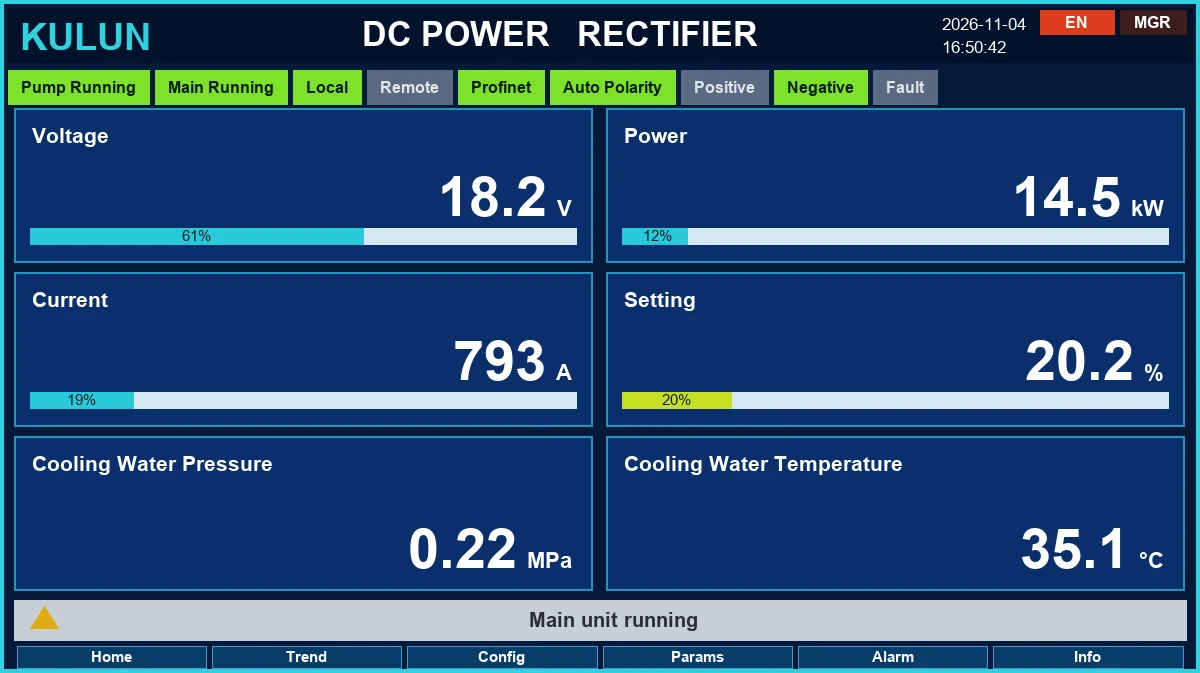
Bottom line first: KULUN DCP3-30V4000A, a water-cooled double-star (anti-parallel star) SCR rectifier rated DC 30 V / 4000 A, is now in service on a silicon steel electrolytic alkaline cleaning line in Tianjin. On the commissioning screen the unit ran at 18.2 V, 793 A and 14.5 kW against a 20.2 % reference, with cooling water at 0.22 MPa and 35.1 °C, PROFINET linked and automatic polarity reversal active.
The cleaning section sits ahead of the annealing furnace. Oil, iron fines and loose dirt carried into the furnace cause roll pick-up, surface marks and atmosphere problems, so the section is treated as quality-critical rather than preparatory. Electrolytic alkaline cleaning makes the strip an electrode in hot caustic: saponification loosens the oil, and gas bubbles forming on the strip lift it away. The supply window that follows is low voltage, high current and near-constant current — public patents on comparable equipment describe a constant-current DC output of roughly 0–36 V at several thousand amps, set by strip width, gauge, line speed and electrode polarity.
What does electrolytic alkaline cleaning need from a DC supply?
Four questions decide the rating, and each has a physical consequence on site. Cell voltage is not fixed — gauge, cell count, plate spacing and liquor conductivity all move it — so rated voltage must cover the highest cell voltage plus busbar drop plus control margin. Rated current must cover the process maximum with continuous duty behind it. The loop must hold current, not just voltage, because cleaning intensity follows current density. And the polarity arrangement has to match the process.
| Process requirement | Supply specification | What to check on site |
|---|---|---|
| Cell voltage varies with gauge and cell count | Rated voltage covers highest cell voltage plus drop and margin | Measured cell voltage, busbar length from rectifier to tank |
| Current density set by line speed and width | Rated current covers process maximum in continuous duty | Process maximum, run hours, cooling water flow and inlet temperature |
| Cleaning intensity must repeat | Closed-loop constant current, reference-to-output linearity | Reference source (local, remote, bus), sampling accuracy |
| Plates need periodic reversal | Polarity reversal or changeover, interlocked with the line | Manual or automatic reversal, interval, whether current may break |
The first row is the one most often missed. A supply rated only against an estimated cell voltage leaves nothing for busbar drop, and the symptom on site is a current that will not climb — the voltage has already reached its ceiling.
Why use a double-star rectifier for this duty?
A double-star circuit is two anti-parallel three-phase half-wave groups feeding one load through an interphase reactor. The reactor absorbs the instantaneous voltage difference between the groups and balances their currents. Because the load current is shared between two branches, the circuit delivers more current from a given device set than a three-phase bridge, and the effective pulse number is higher, so ripple and harmonic content improve. The cost is real: more devices, a dedicated rectifier transformer with a balance reactor, and heavier busbar and cooling work inside the cabinet.
| Aspect | Three-phase bridge | Double star with interphase reactor |
|---|---|---|
| Circuit | Six devices in a bridge | Two half-wave groups in anti-parallel |
| Current path | Full load current through the arms; paralleling once the limit is reached | Shared between two branches, balanced by the reactor |
| Typical current range | Medium voltage, medium to high current | Low voltage, very high current |
| Output ripple | Six-pulse | Higher effective pulse number |
| Balance of plant | Compact, general-purpose transformer | Dedicated transformer, interphase reactor, denser busbar and water circuit |
| This project (30 V / 4000 A) | Not used | Used |
The KULUN DCP3 product page is explicit that both three-phase bridge and double star are available for thyristor rectification, and that the choice follows the output specification and transformer design. Calling one topology the only correct answer would be wrong: at 30 V / 4000 A the double-star arrangement matches the process window, while a high-voltage, low-current duty would point the other way.
How did commissioning go in Tianjin?
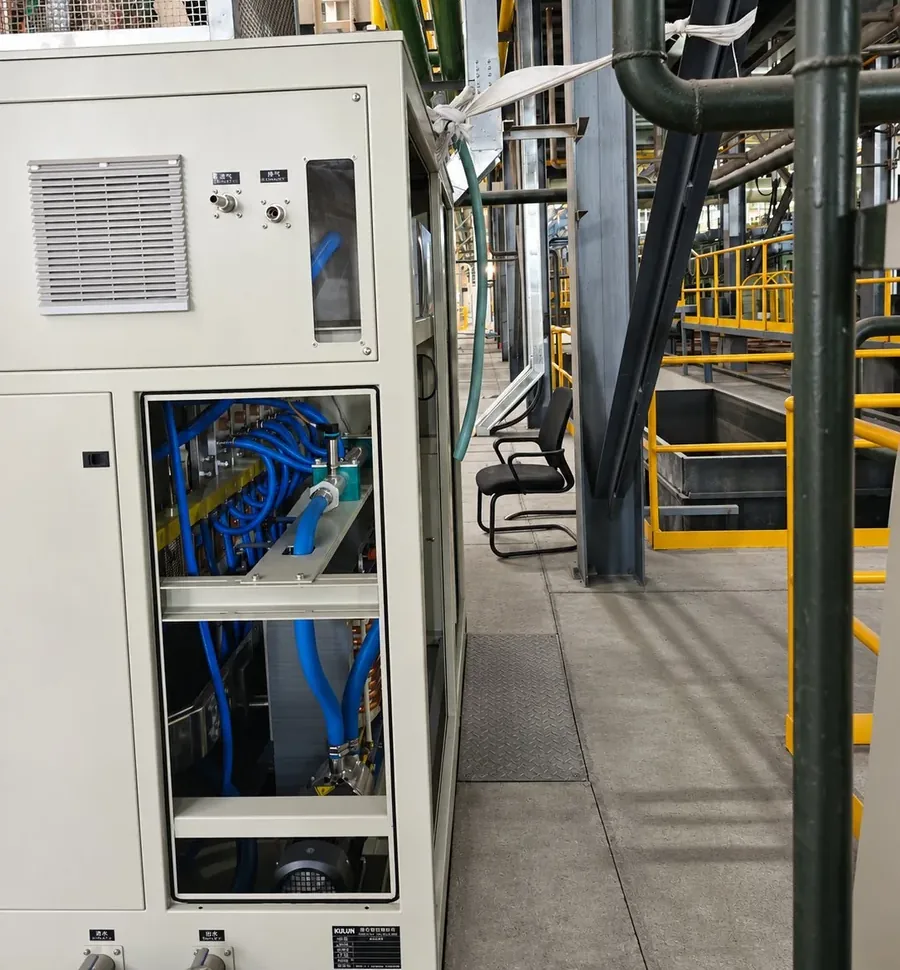
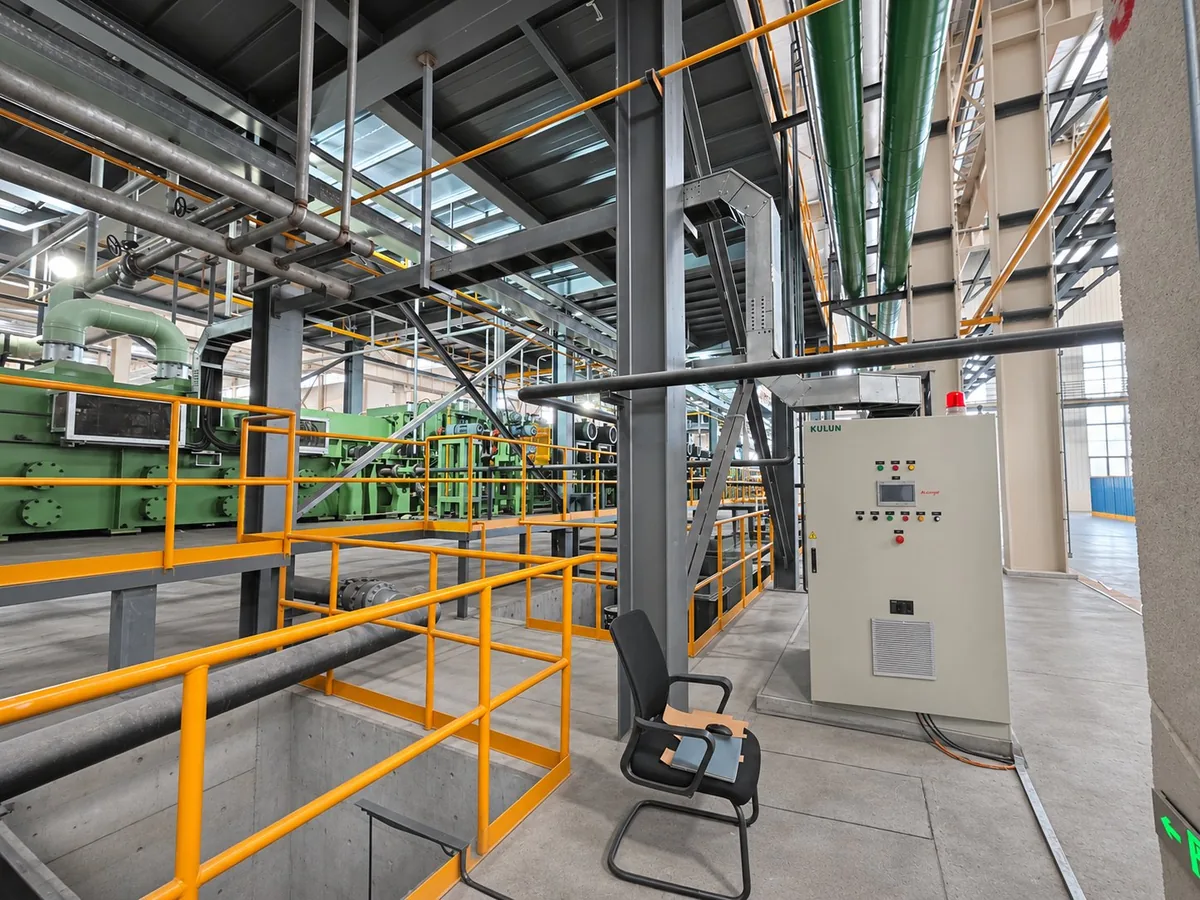
The unit is a DCP3-30V4000A with double-star rectification, installed beside the cleaning section and feeding the plate circuit over a short DC busbar run — at this current level every extra metre of busbar spends voltage headroom the process may later need. Commissioning was completed and the line is in production. The site view shows the cabinet at the line; the screen view records the readings at 16:50 on the commissioning day, with main unit and cooling pump running, local reference, PROFINET up, automatic polarity reversal engaged and negative polarity live.
What do the readings show, and what do they not?
First, a consistency check against the nameplate. 18.2 V is 60.7 % of 30 V and the voltage bar reads 61 %; 793 A is 19.8 % of 4000 A against a 19 % bar; 14.5 kW is 12.1 % of 120 kW against a 12 % bar. The product 18.2 × 793 is about 14.4 kW, matching the 14.5 kW display within rounding. The readings are internally consistent, and they confirm that the rated envelope of this build is 30 V / 4000 A / 120 kW.
| Reading | Display | Bar | Check |
|---|---|---|---|
| Voltage | 18.2 V | 61 % | 18.2 ÷ 30 = 60.7 %, matches |
| Current | 793 A | 19 % | 793 ÷ 4000 = 19.8 %, matches |
| Power | 14.5 kW | 12 % | 14.5 ÷ 120 = 12.1 %, matches |
| Reference | 20.2 % | 20 % | Within 0.4 points of measured current |
| V × A | 18.2 × 793 | — | ≈ 14.4 kW, consistent with 14.5 kW |
Second, linearity. A 20.2 % reference producing 19.8 % of rated current means the operator can set current density for a change of line speed by changing one number, without trimming at the cabinet. That is the practical value of a constant-current loop in a cleaning section.
What the snapshot does not show matters as much. It is one point at roughly one fifth of rated load: it proves the unit runs on the line, that readings agree with the nameplate, and that water and communications are connected. It says nothing about efficiency, harmonic distortion, temperature rise or energy savings, which belong to type testing and project acceptance documents.
Which boundaries apply?
- This article confirms commissioning of the unit described; it does not name the end user and does not publish efficiency, harmonic, temperature-rise or energy-saving figures.
- The 0–36 V and several-thousand-amp figures are industry descriptions from public literature on comparable equipment, not measurements from this installation.
- Cleaning results also depend on liquor concentration and temperature, brushing, squeegee rolls, line speed and plate layout. The supply is necessary, not sufficient.
- Rated voltage and rated current are ceilings, not a working point; both are limited by the approximately 120 kW power envelope.
FAQ
Does 30 V / 4000 A mean 120 kW at full voltage and full current together?
No. The two ratings are ceilings and the product is about 120 kW. The actual operating point is set by load resistance: a high-resistance cell gives high voltage at low current, a low-resistance cell the reverse. The Tianjin screen shows 18.2 V and 793 A, about 14.4 kW, which is roughly one fifth of the envelope.
Is a double-star rectifier always better than a three-phase bridge?
No. Double star wins at low voltage and very high current, where the load current is shared between two half-wave branches and the effective pulse number is higher. It costs more devices, a dedicated transformer with an interphase reactor, and denser busbar and cooling. For moderate current or high voltage, a bridge is simpler and more economical. KULUN supplies both and selects on output specification and transformer design.
Why constant current instead of constant voltage for alkaline cleaning?
Cleaning intensity follows current density, while cell resistance drifts with liquor concentration, temperature, strip gauge and plate condition. On constant voltage the current drifts with it; on constant current the loop holds the setpoint and the process repeats. The 20.2 % reference against 19.8 % measured current on the commissioning screen is that loop working.
Is polarity reversal mandatory?
It depends on the process and plate arrangement. Periodic reversal keeps plate and strip surfaces even and reduces build-up on one side; where the process runs one direction with generous plate area, it can be omitted. This unit has automatic reversal, shown engaged with negative polarity live on the screen. Interval and current-break conditions belong in the process document and the interlock design.
Can these screen readings be used as a performance report?
No. A single snapshot at about 20 % load only shows the unit running, readings consistent with the nameplate, and water and communications connected. Efficiency, harmonics, temperature rise and energy savings require standard test methods and acceptance documents. When reading such a screen, check voltage × current against the power display and each bar against its rating first.
Timeliness note
This article reflects the DCP3-30V4000A commissioning in Tianjin as of November 2026 and the product information visible in November 2026. The model, double-star rectification, silicon steel alkaline cleaning duty, location and commissioned status were provided by the project side; the screen readings are a single snapshot from the commissioning day and do not represent rated-load performance. Rating, topology, transformer configuration, cooling conditions and communication options are governed by the project technical agreement, the product manual and site acceptance documents.