

Electroplating vs Electrolysis Power Supplies: What’s the Difference?
Both belong to DC rectifier power supplies, providing energy to electrochemical processes through stable DC output.
But the process goals they serve differ:
- Plating supplies care more about coating uniformity, adhesion, and appearance quality;
- electrolysis supplies care more about high-current continuous output, energy control, and long-cycle running stability.
So selection cannot look at voltage and current alone — bath scale, process rhythm, control method, and site environment all count. Below, the differences across core needs, output characteristics, and application scenarios.
1. Core Difference: Different Process Goals
| Item | Electroplating supply | Electrolysis supply |
|---|---|---|
| Main goal | Uniform, stable metal coatings | Electrolysis efficiency and continuous production |
| Control focus | Current density, ripple, regulation accuracy | High-current capability, efficiency, temperature rise, reliability |
| Common output | CV, CC, pulse, soft start | Stable DC, high-current continuous output |
| Typical applications | Hardware, electronics, automotive parts plating | Metal electrolysis, wastewater treatment, related electrochemistry |
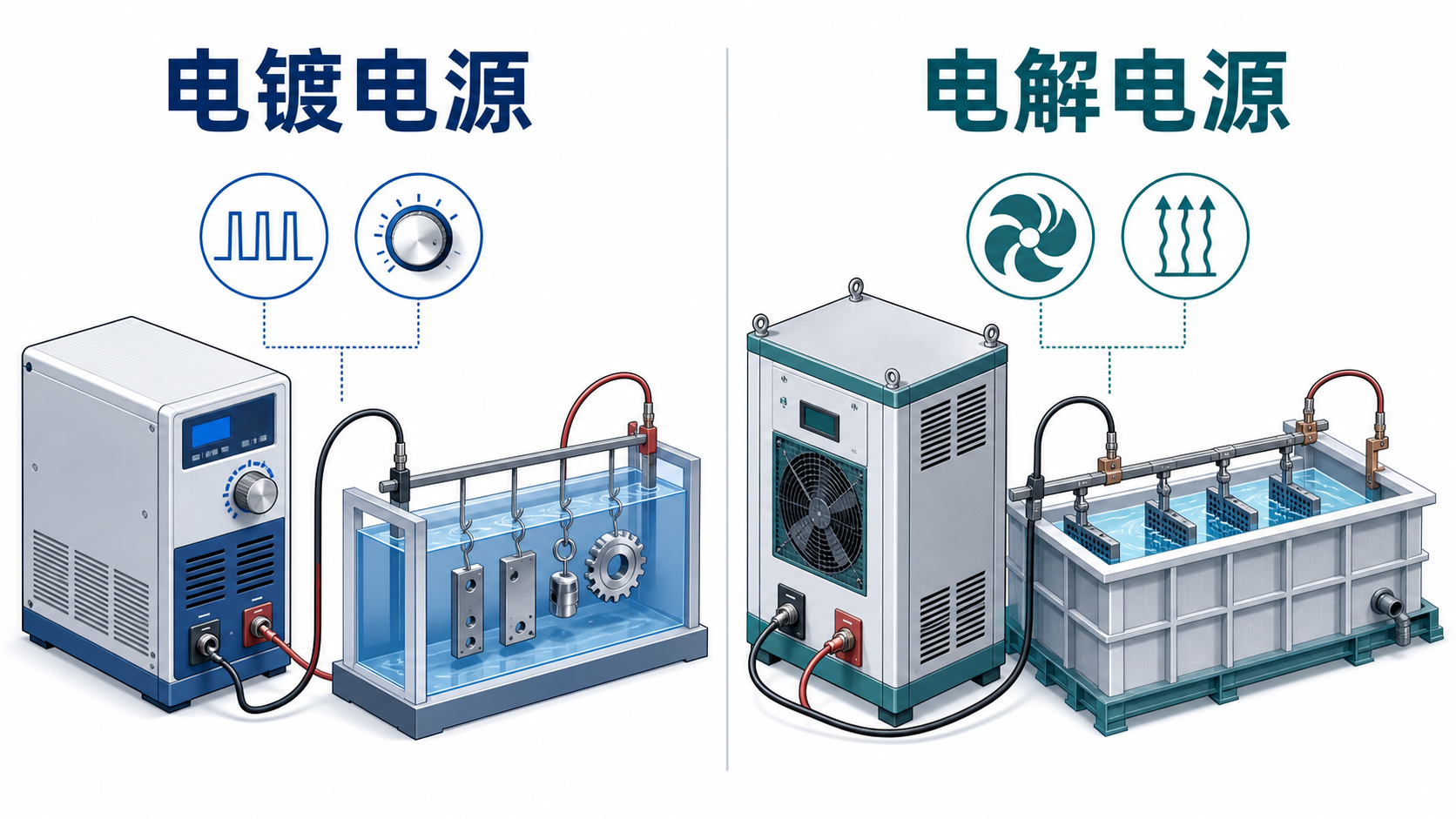
Plating supplies favor refined control; electrolysis supplies favor high-current continuous running and system stability.
2. Plating Supplies: Fine Control Around Coating Quality
- In plating, current density and output ripple directly affect coating uniformity, brightness, and adhesion.
- A plating supply usually needs stable CV/CC capability with fine regulation per process — adapting to different materials, baths, and workpiece shapes.
- For automated lines, pulse output, soft start, overvoltage/overcurrent protection, and remote-control interfaces also matter.
- These functions improve process repeatability and make the supply easier to integrate into production rhythm and automation systems.
3. Electrolysis Supplies: Configured Around Continuous Running and Efficiency
- Electrolysis often means larger baths and longer cycles, demanding more from continuous high-current output.
- Beyond meeting voltage/current ranges, conversion efficiency, temperature-rise control, and cooling design all affect long-term performance.
- Electrolysis-supply design therefore emphasizes structural reliability, heat dissipation, and adaptability to bath conditions.
- For continuous production, also watch protection mechanisms, maintenance convenience, and matching with site supply conditions.
4. How to Choose the Right DC Supply?
- If the process centers on coating quality, thickness consistency, and fine parameter regulation, prioritize control accuracy, ripple level, and pulse functions for plating needs;
- if the process centers on electrolysis reactions and continuous production, focus on high-current capability, cooling method, running efficiency, and long-term stability.
- Note: plating and electrolysis are not entirely separate applications.
- The concrete solution still needs configuration against bath-liquid characteristics, load change, capacity requirements, and automation level — so supply performance matches the real process.
5. KULUN Electric DC Power Solutions
- KULUN Electric provides IGBT DC supplies, rectifiers, and automation-interface packages for plating, electrolysis, and metal surface-treatment processes.
- By selecting against actual load, production rhythm, and site conditions, we help users build supply systems that fit their processes better.