

Conclusion: An SCR power controller regulates voltage to a heater; a VFD regulates frequency and voltage to a motor. Use an SCR controller for electric heating and a VFD where you need motor speed control or soft starting — they are not interchangeable, even though both are power-electronic devices.
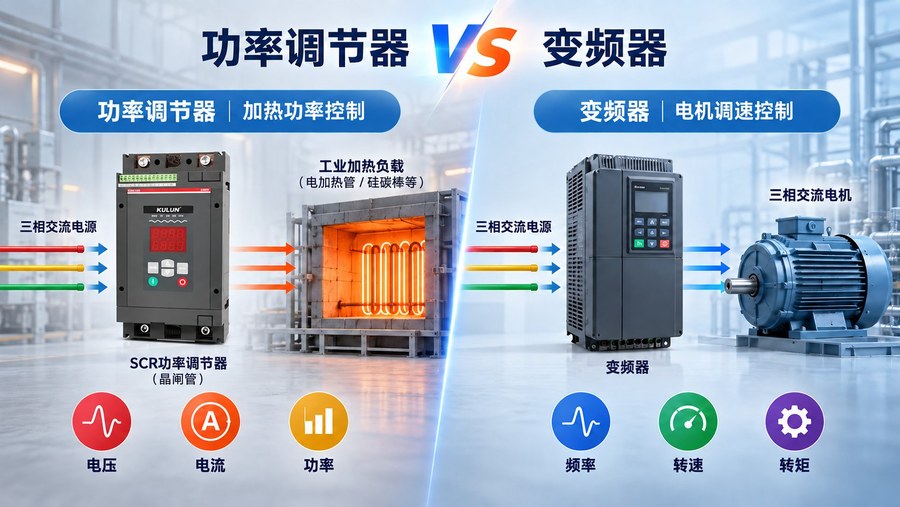
An SCR voltage controller (thyristor power controller) and a VFD (variable frequency drive) are the two most common power-electronic control devices on the industrial floor. They look similar but control different things. In one sentence: an SCR voltage controller decides how much power the load receives; a VFD decides how fast the motor runs. The SCR controller regulates load voltage, current and power at the fixed 50/60 Hz line frequency for electric heating; the VFD converts the supply to a variable voltage and frequency to control motor speed and torque.
Quick answer: heating loads — resistance heaters, SiC and MoSi2 elements, heating transformers — take an SCR voltage controller; motor loads — fans, pumps, conveyors, compressors — take a VFD. On a complete production line both usually coexist: the SCR controller runs the heaters while the VFD runs cooling fans and conveyors.
1. What Is the Core Difference Between an SCR Voltage Controller and a VFD?
The core difference is the controlled quantity: an SCR voltage controller varies the RMS voltage, current and power delivered to the load on the unchanged 50/60 Hz line frequency, while a VFD first rectifies the AC supply to a DC bus and then inverts it to a variable voltage and frequency, controlling speed and torque. The table below summarizes it:
| Item | SCR Voltage Controller | VFD |
|---|---|---|
| Main function | Regulate load voltage, current, power | Regulate motor speed and torque |
| Typical device | SCR (thyristor) | IGBT |
| Controlled variables | Voltage, current, power | Frequency, voltage, speed, torque |
| Output frequency | Fixed at 50/60 Hz | Variable (e.g. 0–50 Hz) |
| Typical loads | Heaters, SiC/MoSi2 elements, heating transformers | Fans, pumps, conveyors, compressors |
| Common control methods | Phase angle, zero crossing, burst firing | V/F, vector control, PWM inversion |
| Main application | Electric heating and temperature control | Motor speed control, soft start, energy saving |
So the single key selection question is: are you controlling heating power or motor speed? The answer determines the device type.
2. Why Do Electric Heating Loads Need an SCR Voltage Controller?
The SCR controller changes the effective voltage, current and power by controlling the thyristor firing (phase angle or zero-crossing switching). Take an industrial resistance furnace set to 1000 °C: the temperature controller or PLC issues a power demand through its PID loop — full power for a fast ramp at low temperature, reduced output near the setpoint, and a small holding power once the temperature is reached — avoiding overshoot and inrush current.
| Load type | Typical application |
|---|---|
| Heater elements, resistance wire | Ovens, heat-treatment furnaces, mold heating |
| SiC and MoSi2 elements | High-temperature industrial and laboratory furnaces |
| Heating transformers | Low-voltage high-current side of special furnaces |
| Multi-zone heaters | Lithium-battery sintering kilns, semiconductor diffusion equipment |
Common control modes are phase-angle, zero-crossing burst firing and variable-period zero-crossing firing, plus constant-voltage, constant-current and constant-power closed loops, soft start, PID control and communication. The KULUN Electric APR3S three-phase SCR power controller and ST200 single-phase SCR power controller, for example, both accept 4–20 mA / 0–10 V control signals and Modbus RTU; for loads whose resistance drifts with aging, such as SiC elements, the constant-power mode automatically compensates the resistance change and keeps the heating power stable.
3. Why Do Motor Loads Need a VFD?
The VFD main circuit is: AC input → rectifier → DC bus → IGBT inverter → variable-voltage variable-frequency AC output. The speed of an induction motor is roughly proportional to the supply frequency (n ≈ 60f/p), so changing the frequency changes the speed smoothly.
A centrifugal fan driven by a VFD, for instance, can run at 20, 30, 40 or 50 Hz to trim the air flow; because fan power rises roughly with the cube of speed, running slower saves significant energy — the reason VFDs are widely used on fans and pumps. Typical loads include fans, pumps, conveyors, mixers, compressors and machine-tool spindle motors.
4. Can a VFD Replace an SCR Voltage Controller for Heating?
Generally no, for four reasons:
- Line-frequency heating loads are purely resistive: they need power regulation, not frequency variation, so an SCR controller is simpler and cheaper;
- Cold SiC and MoSi2 elements have only a fraction of their hot-state resistance — the soft-start and current-limit functions of an SCR controller are designed exactly for this, while a standard VFD has no dedicated heating algorithm;
- VFD output is a high-frequency PWM wave: long cables feeding resistive heaters add line losses and can resonate with cable capacitance;
- The standard industrial-furnace ecosystem (PID loop + temperature controller + 4–20 mA signal into a thyristor controller) is mature and proven.
5. Can an SCR Voltage Controller Replace a VFD for Speed Control?
No. An SCR voltage controller changes only the RMS voltage or power — the output frequency stays at 50 Hz. Induction motor speed depends mainly on frequency: reducing voltage alone increases slip and current, heats the motor and reduces torque, so stable wide-range speed control is impossible. Motor loads that need speed control should use a VFD.
6. Function Boundaries at a Glance
| Function | SCR Voltage Controller | VFD |
|---|---|---|
| Voltage regulation | Yes | Yes |
| Current regulation | Yes | Achievable |
| Power regulation | Yes | Indirect |
| Output frequency change | Normally no | Yes |
| Temperature control | Ideal fit | Not the main purpose |
| Motor speed control | Unsuitable | Yes |
| Constant voltage / current / power | Standard feature | Partially supported |
| PID control | Yes | Yes |
| Modbus communication | Yes | Yes |
7. How to Choose in Practice?
Answer two questions first: what is the load, and which parameter must be controlled? Then match the table below.
| Actual demand | Recommended device |
|---|---|
| Control heater element power | SCR voltage controller |
| Control industrial furnace or oven temperature | SCR voltage controller |
| Control SiC / MoSi2 element heating | SCR controller with constant-power mode |
| Control a heating transformer | SCR controller with soft start |
| Fan speed control | VFD |
| Pump speed control | VFD |
| Conveyor speed control | VFD |
| Motor torque control | VFD |
On a complete production line the two devices normally coexist. In an industrial resistance furnace, for example, the SCR voltage controller powers the heaters while VFDs run the recirculation fans and material-conveyor motors — each device does its own job.
FAQ
Does an SCR voltage controller still output 50 Hz AC?
Yes. Phase-angle and zero-crossing control change only the RMS voltage and current, never the frequency, which is exactly what line-frequency heating loads require.
Why should SiC heating use a controller with constant-power mode?
SiC element resistance rises several-fold over its service life. Under constant-voltage control the power keeps dropping and the furnace never reaches temperature; constant-power mode raises the voltage automatically to compensate and keeps power and temperature stable.
Can one machine use both an SCR controller and a VFD?
Yes, and this is common practice: the SCR controller powers the heating zones while VFDs drive recirculation fans and conveyors, coordinated by the same PLC or temperature-control system.
Is it feasible to drive a heater with a VFD?
Partially feasible but not economical. Resistive heaters need no frequency variation; a VFD adds cost, and its high-frequency PWM output brings extra losses and resonance risk on long heater cables.
Compiled from KULUN Electric product documentation, September 2026. For exact APR3S and ST200 specifications, refer to the product pages and datasheets.
Related Technical Knowledge
SCR vs IGBT Power Supplies: What Are the Differences?
VFD vs Soft Starter: The Simple Differences
Application Case
ST200 50 A SCR Power Controller in the Evaporation Boat Heating Control System