

Which Low-voltage High-current Applications Suit Synchronous Rectification?
What do low-voltage, high-current machines fear most?
Not the lack of power. It’s the heat.
The voltage is modest, but once the current climbs, the voltage-drop loss of traditional diode rectification becomes obvious.
That’s when synchronous rectification should take the stage.
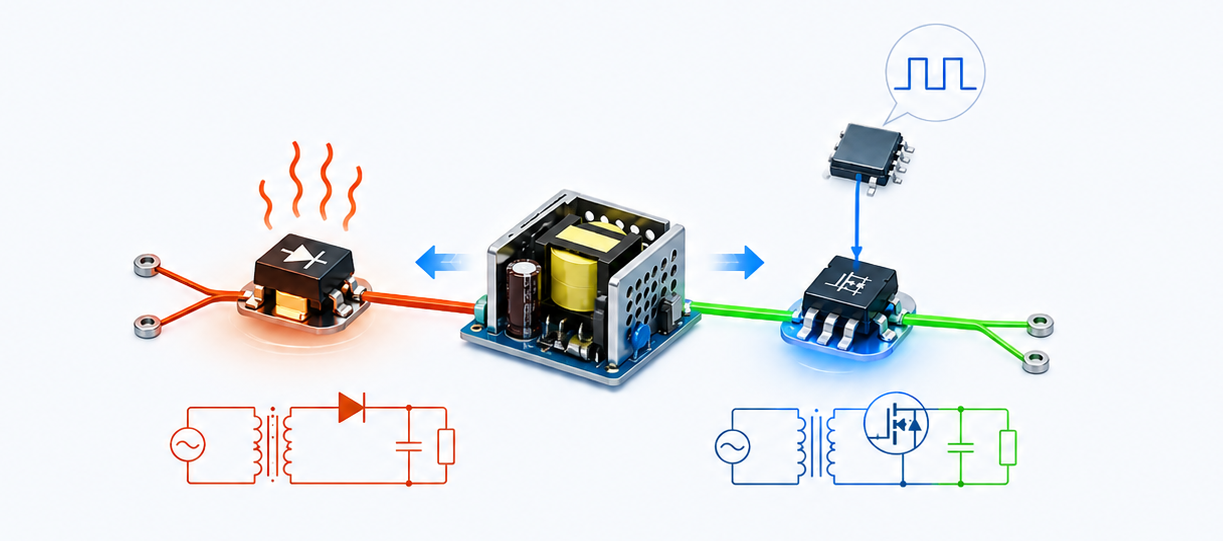
What Is Synchronous Rectification, Simply?
Traditional rectification uses diodes.
Synchronous rectification lets MOSFETs "take over" the rectifying job at the right moment.
Its core logic is simple:
A diode conducts by itself; a MOSFET is switched precisely by a control circuit.
The goal is one: lower loss when current flows, less heat.
How Is It Really Different from Diode Rectification?
A conducting diode has a fairly fixed voltage drop.
The lower the output voltage, the larger the share of that loss.
For example, with only 5 V or 12 V output but tens or hundreds of amperes — the energy the diode itself "eats" can no longer be ignored.
Synchronous rectification replaces the diode with a low on-resistance MOSFET.
The loss changes from "voltage drop × current" to the much lower "current² × on-resistance".
In plain words:
The bigger the current, the more energy you save; the lower the temperature rise, the more relaxed the equipment runs.
Why Use Synchronous Rectification?
Higher efficiency. Under low voltage and high current it effectively cuts rectification-stage loss.
Less heat. Less heat means less cooling pressure and friendlier device lifetime.
Easier size control. At the same power, heatsink and air-duct pressure can be reduced.
Better for continuous duty. For long-time, high-current conditions, efficiency and stability matter even more.
But one honest note:
Synchronous rectification is not a must for every power supply.
It needs drive, timing, and protection coordination — a more complex solution. So it pays off most in low-voltage, high-current, long-running scenarios.
Which Voltage Range Typically?
Rule of thumb: the lower the output voltage, the clearer the advantage.
- 3.3 V, 5 V: very well suited
- 12 V: a common choice
- 24 V: still valuable in high-current scenarios
- 48 V and above: judge together with current, efficiency target, and cost
In one sentence:
Below 12 V with high current — prioritize synchronous rectification.
Which Applications Fit Best?
Electroplating, electrolysis. Low voltage, high current, continuous operation, sensitive to efficiency and temperature rise.
DC heating, electric furnace heating. Needs stable high-current output over long running hours.
Water treatment, surface treatment. Requires constant-current / constant-voltage control and continuous-duty capability.
Steel & metallurgy, non-ferrous metals. Heavy conditions, high current — supply stability is key.
Automation equipment, new-energy materials. Needs wide-range regulation, remote communication, and interlocked control.
Sichuan KULUN Electric: DCA Series High-power IGBT DC Power Supplies
For industrial low-voltage high-current DC output, KULUN Electric’s public product line is the DCA series high-power IGBT DC power supply.
It is built from multiple paralleled DCA DC modules in an N+1 modular design, suitable for electrolysis, electroplating, steel & metallurgy, DC heating, water treatment, and surface treatment.
Reference parameters:
- Power factor: ≥0.95 at full load
- Full-load efficiency: 80%–92%
When selecting, don’t just look at voltage and current.
Also confirm load characteristics, ripple requirements, cooling conditions, control accuracy, and communication needs.
Note: the DCA series is positioned as a high-power IGBT DC power supply; below 20 V a synchronous-rectification topology is generally used — confirm the details with our engineers for your project.
Low voltage and high current is not just about "being able to output".
Bringing loss and temperature rise down is the real efficiency upgrade.