

Bottom line first: AC and DC are equally capable of generating heat — in a resistive load, if the RMS voltage is the same, the heat produced is the same. What actually decides the supply type is the load, the process, and whether an electrochemical reaction is involved. Plating, electrolysis and electrowinning need fixed electrode polarity and therefore DC; molten glass and similar conducting media are heated with AC to avoid continuous one-way ion migration; ordinary resistance furnaces use AC simply because the supply system is simpler. This article starts from the power equations, then sets out which loads need DC, which prefer AC, and the "load first, process second, supply last" selection order.
In industrial electric heating, the same question comes up again and again: if the purpose is only to generate heat, why do some installations run on AC while others must have DC? The sections below answer it in terms of principle, load type and selection sequence.
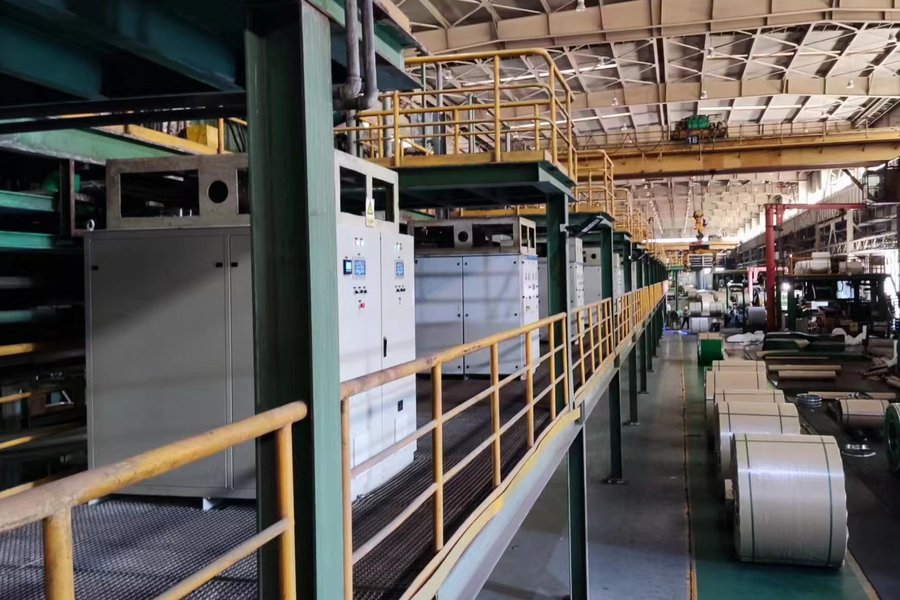
Do AC and DC differ in how they heat a resistor?
Electric heating is the conversion of electrical energy into heat. For a DC load, power is P = U × I. For an AC load, active power is P = U × I × cosφ, where cosφ is the power factor. Only active power is converted into useful energy such as heat.
For heating loads that behave almost as pure resistance, the power factor is close to 1, so AC active power can be written approximately as P ≈ U × I. In terms of resistance, P = U² / R, where the AC voltage is taken as an RMS value.
Example: with a 10 Ω resistor, 100 V DC gives P = 100² ÷ 10 = 1000 W, and 100 V RMS AC gives P = 100² ÷ 10 = 1000 W. Under ideal resistive conditions, AC and DC therefore deliver the same average heating power.
For plain resistance heating: AC is not inherently "hotter", and DC is not inherently more efficient. What has to be analysed is the physical and chemical character of the load itself.
Which loads require a DC supply?
The defining feature of DC is that current direction never changes and electrode polarity is fixed. Any process that needs steady one-way ion migration or an electrode reaction therefore needs DC. Typical cases include:
- electroplating;
- electrolysis;
- electrowinning;
- electrorefining;
- water electrolysis for hydrogen;
- some electrochemical water treatment processes;
- some hydrometallurgical processes.
In electroplating, metal ions must move under the field towards a defined electrode and deposit on the workpiece. With ordinary AC the current reverses periodically, cathode and anode keep exchanging roles, and a stable one-way deposition process is impossible. Plating lines therefore use AC network → rectifier → low-voltage high-current DC output, implemented as a thyristor rectifier or an IGBT high-frequency DC supply depending on power, current and dynamic response requirements.
One point worth stressing: the presence of a liquid does not by itself require DC. What decides it is whether the medium conducts by ions and whether the process needs a continuous, directional electrochemical reaction.
Which loads are better suited to AC?
Opposite to plating and electrolysis, some loads generate heat resistively but must not be subjected to long-term one-way electrochemical action. A prime example is direct electric heating of molten glass.
Molten glass conducts ionically at high temperature. With electrodes immersed in the melt, the glass itself acts as the resistive load and generates Joule heat. From a pure heating standpoint both DC and AC work; under a sustained DC field, however, ions keep migrating in one direction, producing polarisation, electrode reactions and local composition changes near the electrodes.
Glass furnaces and electric boost melting therefore use AC: the periodically reversing field suppresses continuous one-way migration. This shows that AC is chosen not because it heats more efficiently, but because it suits the process characteristics of that conducting medium.
Why do ordinary resistance furnaces mostly run on AC?
For standard industrial furnaces and heaters with resistive loads — resistance wire, sheathed heater elements, metallic heating elements, SiC rods, MoSi₂ elements, some graphite heaters — both AC and DC produce Joule heat in principle. In practice AC dominates, and the reason is supply system structure rather than heating physics.
Plants already have three-phase AC at 380 V, 400 V or 690 V, so the chain can simply be three-phase AC network → SCR power controller → heating load: few components, simple structure, easy maintenance. Converting AC to DC without a process reason (AC → rectifier → DC → load) adds rectifier devices, filtering and the associated protection. For plain resistance heating with no special requirement, AC is therefore the more common engineering choice.
Which heating loads can run on either AC or DC?
Some loads have no significant electrochemical process and exist purely to generate heat — certain metallic resistance elements, graphite heaters, carbon-based elements, special conductive materials and resistive process loads. In principle they accept AC or DC.
But "possible in principle" is not "interchangeable in practice". Check the rated voltage and current of the element, the cold-to-hot resistance change, the output capability of the supply, whether a transformer is needed, the power control method, harmonics and power factor, control accuracy, equipment cost, cooling and protection, and any process requirement on current waveform. For graphite and SiC elements in particular, resistance shifts noticeably with temperature and ageing, so a supply cannot be selected on rated power alone.
DC versus AC: typical applications compared
| Load or process | Usual supply | Purpose | Reason |
|---|---|---|---|
| Resistance furnace | Mainly AC | Resistive heating | Simple system, fed directly from the AC network |
| Sheathed heater elements | Mainly AC | Resistive heating | Simple structure, low cost |
| SiC (silicon carbide) heating | Mainly AC | Resistive heating | Easy voltage and power control |
| MoSi₂ heating | Mainly AC | Resistive heating | Standard supply for industrial furnaces |
| Graphite heating | AC or DC | Resistive heating | Set by process, voltage and current |
| Electroplating | DC | Metal deposition | Fixed electrode polarity required |
| Electrolysis | DC | Electrochemical reaction | One-way ion migration required |
| Electrowinning | DC | Metal deposition | Stable DC current required |
| Electrorefining | DC | Metal refining | Fixed anode and cathode required |
| Water electrolysis for hydrogen | DC | Electrolysis reaction | Stable electrode reaction required |
| Direct heating of molten glass | Mainly AC | Joule heating | Reduces continuous one-way migration and polarisation |
Selection logic: judge the load first, then the supply
In a real project, "should I use AC or DC?" is the wrong opening question. The order is:
Step 1 — identify the load. Pure resistance, inductive load, arc load, conductive liquid, electrolytic cell, electrode heating or graphite heater? Each places completely different demands on dynamic behaviour and control.
Step 2 — decide whether an electrochemical process exists. If the process needs directional ion migration, fixed electrode polarity, metal deposition or an electrolysis reaction, DC is normally mandatory. If it must avoid polarisation caused by a sustained one-way field, AC is usually the better fit.
Step 3 — choose the power control scheme. For AC heating, options include SCR phase-angle control, zero-crossing control, variable-cycle control, a variable transformer, or a medium/high-voltage AC power control system. For DC, options include thyristor rectifier supplies, IGBT high-frequency DC supplies, PWM DC supplies and low-voltage high-current DC supplies. AC versus DC is only one step in the whole selection.
FAQ
Q: Why must plating and electrolysis use DC?
A: Both processes rely on directional ion migration and fixed electrode reactions: metal ions must deposit only on the cathode (the workpiece) while oxidation occurs at the anode. AC reverses polarity many times per second, swapping cathode and anode continuously, so no stable deposition is possible. Plating, electrolysis, electrowinning, electrorefining and water electrolysis therefore all need a rectified DC supply, with requirements on current stability and ripple set by the process.
Q: Why is glass melted with AC rather than DC?
A: Molten glass is an ionically conducting medium and heats like a resistor under either supply. But a sustained DC field drives ions continuously in one direction, causing polarisation and electrode reactions near the electrodes, electrode attack and local composition changes in the melt. AC, with its periodically reversing field, largely suppresses that migration, so direct electric heating of glass is normally done with AC.
Q: Would a resistance furnace save energy on DC?
A: No. Resistive heating depends only on active power P = U²/R: 100 V DC and 100 V RMS AC produce identical heat in the same resistor. Rectifying AC into DC adds rectifier devices, filtering and protection, plus their losses. Ordinary resistance furnaces use AC because the supply structure is simpler and easier to maintain — not because DC cannot heat or AC is more efficient.
Q: Graphite heaters accept AC or DC — what matters when choosing?
A: Focus on the cold-to-hot resistance change and on current capability. Graphite resistance varies markedly from cold to operating temperature and drifts as the element ages, so the supply needs sufficient voltage and current range plus suitable control (constant current, constant power, or closed-loop control with resistance compensation). Also check whether a transformer is required, harmonic and power-factor limits, cooling conditions and any process constraint on current waveform — do not size the supply from rated power alone.
Timeliness note
This article reflects general engineering practice and industrial power supply practice as of September 2026, and discusses the difference between AC and DC heating and the selection approach. The final scheme must follow the process requirements, the element data sheet and the technical agreement with the equipment manufacturer; the calculation example illustrates the principle only and does not represent any specific product parameter.
Related Technical Knowledge
MoSi2 Heating Control: Traditional SCR vs Layered SCR vs IGBT DC
How to Choose Industrial Heating Power Supplies: SCR Controllers, Rectifiers, and IGBT Supplies
Application Case
KULUN 42 MW Ultra-high-power DC Power Supply Commissioned at the Tongwei Cangxi Silicon Project