

Bottom line up front: 3 kV, 6 kV and 10 kV are not performance grades — they are matching grades. The voltage class of a high-voltage power control cabinet is set by three things, in order: the plant grid voltage, the load power and current, and the voltage the load itself is rated for. Once all three are checked, the answer is usually a single option. This guide gives the decision basis for each class, a worked 6 MW current comparison, application tables and the thyristor series design trade-offs behind each voltage level.
In industrial electric heating, molten salt energy storage, glass, metallurgy, silicon materials and large electric furnace projects, high-voltage power control cabinets are commonly built for 3 kV, 6 kV or 10 kV. A frequent misconception is that a higher voltage means a more capable cabinet. In practice, the voltage class is a result of the supply condition and load matching, not a sign of advanced design.
Why is voltage class not a performance grade?
A low-voltage SCR power controller can be rated 800 A or 1000 A, while a high-voltage cabinet may be rated only 50 A. Capacity (power and current) determines what the equipment can do; voltage class is determined by the system architecture. The same 6 MW load draws about 1155 A on a 3 kV system but only about 346 A on a 10 kV system. Likewise, a 10 kV cabinet built for 300 A and one built for 800 A are entirely different designs. So selection does not start with comparing ratings — it starts with establishing what voltage the system needs.
Basis one: what voltage does the grid supply?
A high-voltage power control cabinet is fed directly from the upstream busbar, so its rated voltage must match the upstream supply:
| Plant supply condition | Usual cabinet choice | Note |
|---|---|---|
| 3 kV busbar | 3 kV cabinet | Direct connection, no transformer |
| 6 kV or 6.6 kV busbar | 6 kV cabinet | For 6.6 kV, check the insulation level limit |
| 10 kV busbar | 10 kV cabinet | The most common medium-voltage distribution level |
If the plant is already supplied at 10 kV and the heating load can accept 10 kV directly, a 10 kV cabinet is the reasonable choice. If the equipment still needs a dedicated step-down transformer, the cabinet voltage class follows the rated voltage of the transformer primary. The rule is simply this: the cabinet rated voltage must match both the upstream supply and the downstream load system.
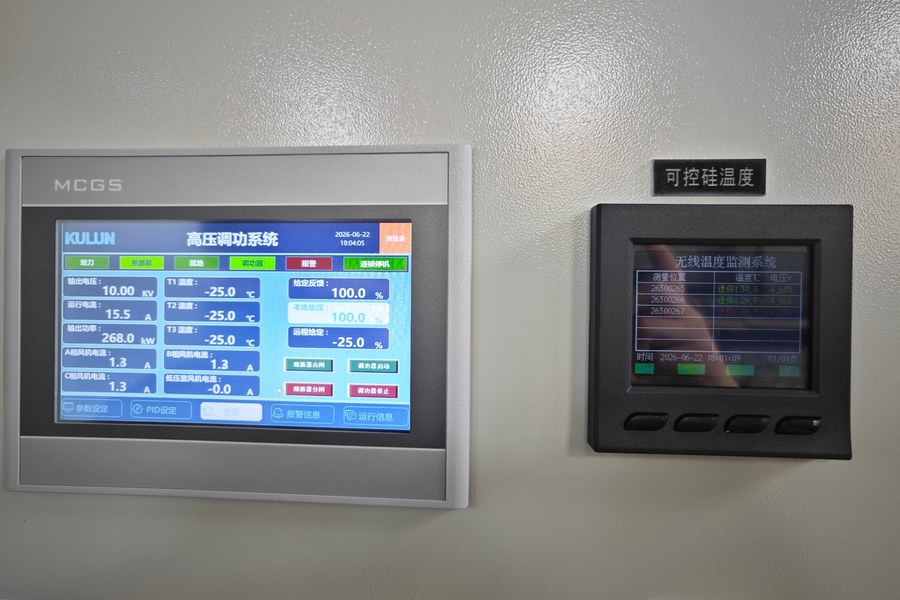
The picture below shows the operator panel of a KULUN 10 kV high-voltage power control system. The screen reads "Output voltage 10.00 kV, output power 268 kW" — a direct example of a cabinet matched to a 10 kV busbar:
Basis two: how large are the load power and system current?
At the same power, a higher voltage means a lower current. In a three-phase system, P = √3 × U × I × cosφ. For a 6 MW load with a power factor close to 1:
| Voltage class | Current at 6 MW (approx.) | Effect on the distribution system |
|---|---|---|
| 3 kV | 1155 A | Large cable and busbar sections, high switchgear rating |
| 6 kV | 577 A | Current halved; distribution cost and losses fall clearly |
| 10 kV | 346 A | Lowest current; suited to large capacity and long feeders |
Current directly affects cable cross-section, busbar size, switchgear rating, conduction loss, heat generation and distribution investment. For multi-megawatt or tens-of-megawatt electric heating systems, raising the working voltage reduces current and distribution losses. That does not mean higher is always better — higher voltage also brings higher insulation, device and safety costs, and for small capacities raising the voltage is usually a net loss.
Basis three: what voltage is the load itself rated for?
In many projects the final voltage class is decided not by the cabinet but by the load. High-temperature resistance furnaces, electrode heating equipment, molten salt heaters and large industrial furnaces all have their own rated voltage and rated power.
If the heater is designed for only a few hundred volts, you cannot simply apply 10 kV because a 10 kV busbar happens to be available. The usual structure in that case is:
10 kV grid → high-voltage power control cabinet → transformer → low-voltage high-current load
Some large high-voltage heaters are designed for 6 kV or 10 kV and can be supplied directly at that level. So before selecting a cabinet, confirm this: is the load a high-voltage load, or a low-voltage load fed through a transformer?
What are 3 kV, 6 kV and 10 kV each suited to?
| Voltage class | Typical characteristics | Common applications |
|---|---|---|
| 3 kV | Lower insulation and device requirements, higher system current | Medium-capacity electric heating equipment, some dedicated industrial furnaces |
| 6 kV | Balanced current, insulation and cost | Large industrial furnaces, high-temperature heating, metallurgical equipment |
| 10 kV | Suited to large capacity, long feeders and direct 10 kV plant supply | Large molten salt heating, glass, metallurgy, new energy and other megawatt projects |
There is no need to choose 10 kV for a small installation just to have "high voltage". For systems of 5 MW, 10 MW or more, staying at a lower voltage drives current up quickly and makes busbars, cables and switchgear disproportionately large — raising the voltage class pays off there.
Why does a higher voltage class make cabinet design harder?
High-voltage power control cabinets use several thyristors in series to achieve high-voltage power control. The higher the voltage class, the more demanding the following: number of series thyristors, static and dynamic voltage sharing, RC snubber networks, overvoltage protection, trigger synchronisation, main circuit insulation distance, creepage distance, high/low voltage isolation, and thermal design.
On a 10 kV system, for example, a single 6500 V thyristor cannot withstand a peak voltage of about 9.8 kV on its own. Several devices must be connected in series, supported by R and RC voltage-sharing networks plus BOD forced triggering protection. A 10 kV cabinet is therefore not a 6 kV cabinet with higher insulation — it is a redesign of the whole power stage, insulation structure and protection system. That is one of the main differences between high-voltage power control equipment and ordinary low-voltage SCR controllers.
How to decide quickly in a real project?
Confirm four parameters before selecting: upstream grid voltage, load rated voltage, maximum power and maximum operating current. Then decide whether a transformer is needed, and whether the cabinet sits on the transformer primary or secondary. In short: the voltage class follows the system architecture, the capacity sets the current, and the load determines the final control method — it is not a matter of asking which of 3 kV, 6 kV or 10 kV is better.
Selection checklist
| Check item | What to confirm |
|---|---|
| Upstream grid voltage | 3 kV / 6 kV / 10 kV, equal to the cabinet rated voltage |
| Load rated voltage | Direct high-voltage connection, or step-down transformer |
| Maximum power | Sets the current rating and device paralleling scheme |
| Maximum operating current | Check thyristor, busbar and cable current-carrying capacity |
| Control mode | Phase-angle / fixed-period zero-crossing / variable-period zero-crossing, and whether switching is needed |
| Protection system | Voltage sharing, RC snubber, BOD protection, overcurrent and over-temperature protection |
| Communication interface | Protocol with the DCS or PLC, for example Modbus RTU |
| Environmental conditions | Ambient temperature, altitude (derating above 1000 m), IP rating |
Frequently asked questions
Q: The plant has a 10 kV busbar and the load is a 6 kV heater — can a 10 kV cabinet be used directly?
A: Not by simply connecting them. Applying 10 kV output to a 6 kV load exceeds its insulation and withstand level. The permissible overvoltage factor of the load must be evaluated; the usual solution is a 6 kV cabinet with a transformer, or a customised scheme after confirming the load insulation margin with the manufacturer.
Q: For a 6 MW load, should I choose 3 kV or 10 kV?
A: At 3 kV the current is about 1155 A, which means large busbars and switchgear investment and higher losses. At 10 kV the current is about 346 A, which saves on the distribution side. If the upstream supply is 10 kV and the load allows it, prefer 10 kV; if only a 3 kV busbar exists, there is no choice to make.
Q: Does a higher voltage class always mean a more expensive cabinet?
A: The cabinet itself becomes more expensive as the voltage class rises (insulation, series thyristors, triggering and protection), but the distribution side becomes cheaper because the current falls. What should be compared is the total investment in cabinet plus distribution, not the cabinet alone.
Q: Should the cabinet be installed on the transformer primary or secondary side?
A: It depends on the load voltage. When the load is high-voltage (6 kV or 10 kV), the cabinet is on the primary side and outputs high voltage directly. When the load is low-voltage and high-current, the cabinet regulates on the primary side and the transformer steps the voltage down, which avoids the losses of regulating very large currents at low voltage — but the transformer must then be designed for the regulation range.
Q: Does an installation altitude above 1000 m affect the voltage class?
A: Yes. Air insulation strength falls as altitude increases, so external insulation must be corrected and equipment generally has to be derated. For plateau projects, state the installation altitude at the enquiry stage so the manufacturer can calculate the insulation margin.
Note: this article is compiled from current GB/T standards and general industry design practice; product parameters are subject to the manufacturer's latest technical specification. Content updated in September 2026. If standards are revised or products are updated, refer to the latest version.
Related technical articles
How to Select a High-voltage Power Control Cabinet
Why Do SiC and MoSi2 Heating Need Constant-power SCR Control
Application case
KULUN 10 kV High-voltage Power Control Cabinet Passes Factory Acceptance Test