

What Is a Bipolar DC Power Supply? Two Common Commutation Topologies Explained
A bipolar DC power supply is one that can switch the output polarity between forward and reverse according to a set program. This switching process is usually called "commutation" (polarity reversal).
It is more than simply swapping plus and minus — it serves electroplating, electrolysis, surface treatment, electrochemistry, and research testing. Forward/reverse switching helps improve coating uniformity and density, reduces burrs and nodules, and raises the surface quality of workpieces.
Two Common Commutation Topologies
Today there are two mainstream implementations: two sets of SCR positive/negative full-bridge rectifiers, and an IGBT DC power supply combined with MOSFET commutation.
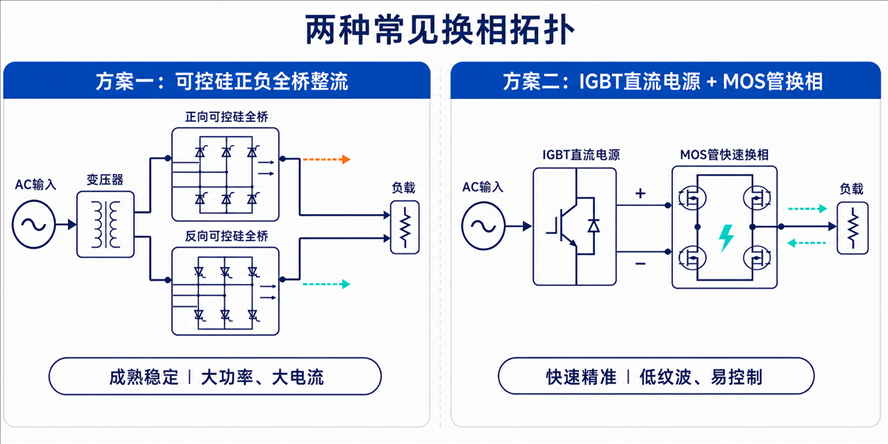
Figure: two common commutation topologies for bipolar DC power supplies.
Option 1: Two Sets of SCR Positive/Negative Full-bridge Rectifiers
This option uses two SCR full-bridge rectifier circuits, responsible for forward output and reverse output respectively. When forward operation is needed, the forward bridge supplies power; when reverse is needed, it switches to the reverse bridge.
Main characteristics:
- Mature technology, stable operation, high reliability;
- Suits high-power, high-current DC output scenarios;
- Strong surge tolerance and rich maintenance experience;
- Relatively large footprint; commutation speed and waveform control are relatively limited.
Where it fits: high-current electroplating, electrolysis, and electrochemical processing — processes with high stability and power requirements but modest commutation-speed requirements.
Option 2: IGBT DC Power Supply + MOSFET Commutation
Here a front-end IGBT high-frequency DC power supply provides stable DC output, and back-end MOSFETs perform fast commutation. The IGBT stage focuses on efficient, stable power delivery; the MOSFETs handle the fast forward/reverse switching.
Main characteristics:
- Faster commutation, suitable for high-frequency forward/reverse processes;
- Higher output accuracy and lower ripple;
- Easy to implement pulse, program, and intelligent control;
- More compact and more efficient, but with higher control and protection design requirements.
Where it fits: high-precision plating, precious-metal plating, PCB plating, R&D experiments, and applications with demanding commutation speed, output ripple, and process consistency.
How to Choose Between the Two?
| Item | SCR dual full-bridge | IGBT + MOSFET commutation |
|---|---|---|
| Commutation speed | Relatively slow | Fast |
| Output accuracy & ripple | Meets conventional process needs | Higher accuracy, lower ripple |
| Strengths | Mature, stable, high current | Fast, precise, flexible control |
| Typical applications | High-power plating, electrolysis | Precision plating, pulse processes, R&D testing |
Sichuan KULUN Electric: Bipolar DC Solutions Matched to Your Process
KULUN Electric provides bipolar DC power supplies and related rectifier solutions according to the customer’s actual process. For different voltage, current, commutation time, control mode, cooling method, and protection requirements, we can match a suitable SCR rectifier or IGBT high-frequency commutation solution.
Choosing a power supply is not only about power size — it is about whether it fits the real process. For mature, stable, high-current applications, consider the SCR option; when commutation speed, low ripple, and precision control matter more, the IGBT DC power supply with MOSFET commutation is the better choice.