

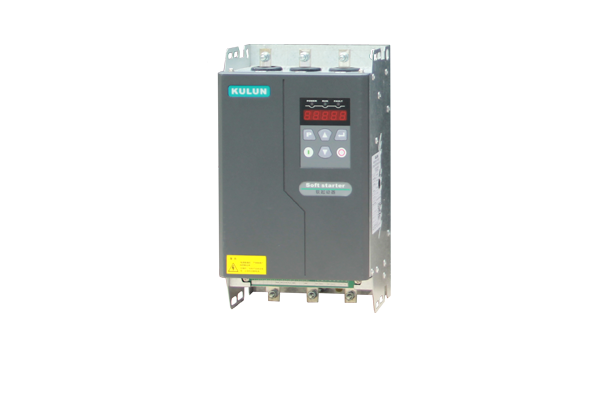
Three-phase induction motors have many advantages but two serious weaknesses: poor starting performance and poor speed-control performance. With the development of power semiconductors and the application of high-power transistors in industrial control, two typical products have greatly improved these weaknesses: the variable frequency drive (VFD) and the soft starter. The VFD improves speed control; the soft starter improves starting performance. This article shares the basic knowledge of soft starters.
Soft starters offer soft start, soft stop, pump control, timed low-speed running, and more, giving them advantages over traditional reduced-voltage starters that are hard to match in industrial and building-services power-equipment control. Their features and cautions follow.
1. Features
(1) Soft start
During the starting time ts, the motor terminal voltage rises gradually from the set initial value to full voltage, and the motor accelerates smoothly and steplessly. ts is adjustable (usually 0.5–60 s), which helps coordination with low-voltage breakers and prevents their instantaneous trips from false-tripping during motor starting.
(2) Pump control
When pumps start and stop, water flow hammers the piping, producing severe water-hammer effects. Although plumbing measures exist to mitigate water hammer, a soft starter with pump-control function can eliminate it completely — reducing mechanical maintenance, saving system repair costs, and ensuring reliable water supply. This function is optional and can be noted on the supply drawing.
(3) Overload protection
Conventional motor overload protection relies on thermal elements, which struggle to avoid the motor’s starting current and may false-trip during starting. Users often raise the thermal element’s trip current to avoid this, leaving the protection insensitive and practically decorative. A soft starter’s built-in overload protection selects different trip-characteristic curves according to starting severity (starting time), avoiding false trips during starting. Being programmable, it gives users greater flexibility — and choosing a soft starter with built-in overload protection can eliminate the thermal relay, simplifying cabinet wiring.
(4) Parameter display
Via keys on the display window, users can view motor running parameters — three-phase voltage, three-phase current, power factor, running time, and more — without adding any instruments, making it easy to check various parameters during operation.
(5) Periodic automatic test-run of fire pumps
Fire pumps are emergency facilities that sit idle for long periods and can seize. If they fail to run when a fire breaks out, firefighting is compromised with serious consequences. Design codes recommend periodic automatic test runs and self-checks for important fire loads such as fire pumps, smoke exhaust fans, and pressurization fans. A soft starter with timed low-speed running can start and stop automatically at user-set intervals, performing periodic test runs and self-checks on fire pumps — improving the reliability and emergency readiness of firefighting facilities.
(6) Principle and wiring
The soft starter uses three-phase anti-parallel thyristors as a voltage regulator between the supply and the motor stator. When starting, the thyristor output voltage rises gradually and the motor accelerates until the thyristors conduct fully; the motor then works on its rated-voltage characteristic, achieving a smooth start, reducing starting current, and avoiding overcurrent trips. The start ends when the motor reaches rated speed.
2. Cautions
(1) Choose protection functions per application
Some soft starters include multiple built-in protections — stall and locked-rotor detection, phase balance, underload, undervoltage, overvoltage, and more — giving the motor further protection. At design time, select or disable protections by programming as appropriate. Design codes state that for circuits where a sudden power loss causes more damage than overload, overload protection should act on alarm rather than tripping. For fire-pump control systems, motor protection is not the priority — some protections can be disabled by programming to act on alarm only; the same applies to the overload protection mentioned above.
(2) Fast fuses for thyristor protection
Since a soft starter itself has no short-circuit protection, fast fuses should protect its thyristors (a low-voltage breaker’s 0.1 s clearing time is too slow to protect thyristors effectively). Select the fast fuse according to the soft starter’s rated current per the maker’s catalog.
(3) Isolation for maintenance safety
When a soft starter stops a motor, only the thyristors stop conducting — there is no electrical isolation between motor and supply. Servicing the downstream circuit or motor in this state is unsafe, so a breaker should be installed ahead of the soft starter in the motor’s primary control loop.
(4) Bypass contactor to reduce harmonics
Because soft starters use nonlinear devices such as thyristors, a large unit or many units can pollute the grid with higher harmonics and interfere with electronic equipment in the building. A bypass contactor can then be fitted: after the soft starter brings the motor smoothly to normal speed, contactor K closes and shorts out the soft starter — the high-power thyristors stop conducting after starting, reducing harmonic interference with the grid and electronics.
(5) Cooling and ventilation
A soft starter dissipates heat when carrying current; leave space above and below it for air to flow through its power module. For higher rated currents, use fan cooling — the fan supply can come from the motor control system’s secondary circuit.
In summary, the soft starter is a modern, high-performance starting device and a mainstream choice among AC induction-motor starters.