

In industrial electric-heating systems, when multiple SCR power controllers run zero-cross control simultaneously, they may output together and switch off together, causing obvious current fluctuation on the supply bus. The APR3 smart power-distribution function coordinates the output timing of multiple controllers to stagger operation as far as possible, reducing waveform superposition and instantaneous inrush.
Why Does Simultaneous Zero-cross Switching Create Surges?
APR3-series power controllers suit resistive, variable-resistance, and inductive loads, and support constant-current, constant-voltage, and constant-power modes. When many controllers run in zero-cross mode, several units may output at the same moment or switch off at the same moment, producing large bus-current swings.
When supply capacity is limited, this instantaneous power stacking can also shock the supply voltage, making the supply transformer or generator set noisy — in severe cases even tripping. Core problem: if multiple zero-cross controllers overlap heavily in output timing, instantaneous bus currents stack up.
What Is APR3 Smart Power Distribution?
APR3 smart power distribution does not simply limit each unit’s output power; it coordinates timing among multiple controllers to minimize the probability of different loads conducting simultaneously.
Multiple APR3 controllers can be chained through high-speed programmable input/output interfaces, with the I/O functions defined in software, achieving smart power distribution among the units.
Working logic: units run staggered as far as possible, reducing waveform superposition and instantaneous inrush.
How Does It Work?
Fixed-cycle zero-cross smart distribution
In fixed-cycle smart distribution, as soon as the previous controller finishes its output window, the next controller starts immediately, and so on in sequence.
This way the output windows of multiple controllers are staggered as much as possible, reducing waveform superposition and instantaneous inrush current.
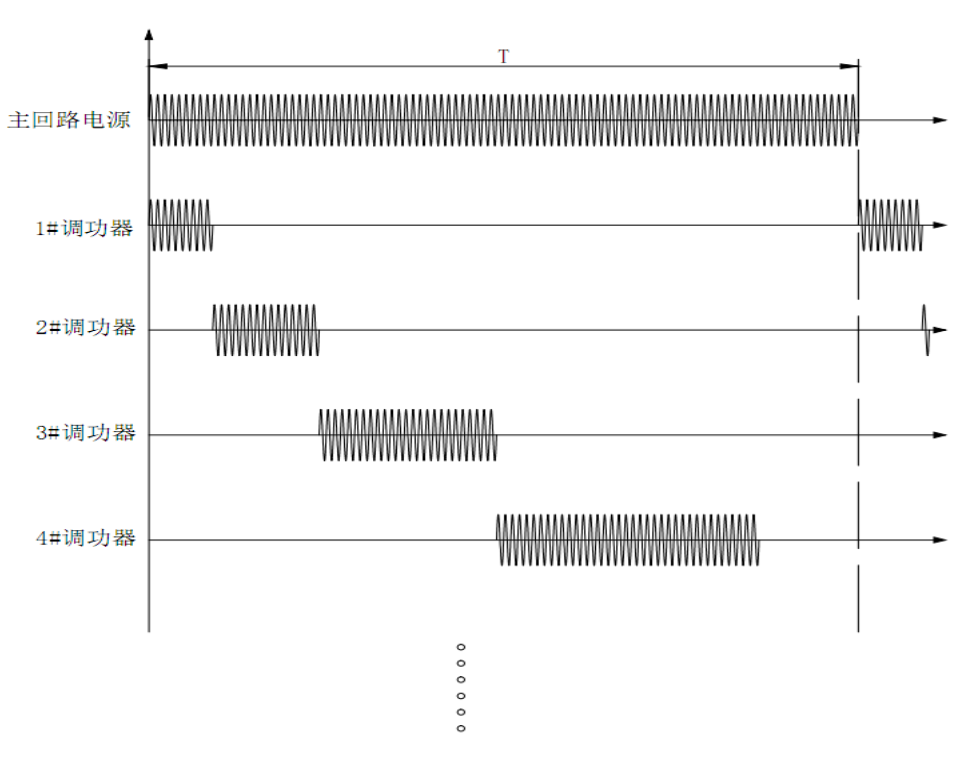
Figure 1: fixed-cycle zero-cross smart power distribution. When one controller finishes output, the next starts in turn.
Variable-cycle smart distribution
The APR3 technical documentation also illustrates variable-cycle smart distribution, whose goal is likewise to reduce the probability of multiple loads working simultaneously by coordinating output timing.
The diagram uses colors to distinguish controllers: #1 black, #2 yellow, #3 red, #4 blue.
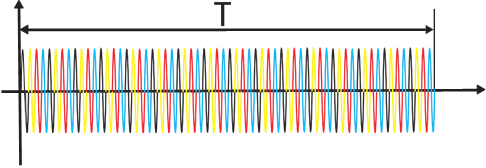
Figure 2: variable-cycle zero-cross smart power distribution. Different colors show different controllers’ output waveforms.
Feature Highlights
Supports coordination of any number of controllers
Through the programmable I/O interfaces and software settings, power distribution among multiple controllers is achieved. The current technical documentation describes the function as usable for coordination of any number of controllers.
One unit’s failure does not affect the others
When any controller fails, stops, or runs at full power, the others keep working normally — the system automatically re-groups around the fault point and continues power distribution.
Units can start and stop at any time
Each controller can start or stop at different times; the system recognizes the current working state and distributes power intelligently according to the online units.
Applicable Scenarios
- Multiple high-power SCR controllers running on the same supply bus;
- Multiple heating zones all using zero-cross control;
- Systems whose supply capacity must be evaluated against simultaneous multi-unit operation;
- Industrial electric-heating systems aiming to reduce power concentration from simultaneous load pickup.
Whether to enable smart power distribution should be judged together with load count, per-unit power, supply capacity, and site operating practice.
Configuration and Wiring Notes
APR3 smart power distribution uses the units’ high-speed programmable input/output interfaces for multi-unit connection, with the I/O functions defined in software.
The technical documentation specifically notes: if a project needs the smart power-distribution function, state it in advance at the ordering stage.
FAQ
Why do multiple SCR controllers need staggered operation?
When multiple zero-cross controllers switch on at the same moment, their load currents stack, causing large instantaneous bus-current changes. Staggered operation minimizes power concentration from simultaneous pickup.
What is APR3 smart power distribution?
Its core is coordinating output timing among multiple controllers to minimize overlapping output windows — not simply limiting each unit’s rated output.
Does it limit per-unit power?
No. It is not simple per-unit limiting; it reduces the probability of simultaneous conduction through timing coordination.
Does one failed unit affect the others?
Per the documentation, when any controller fails, stops, or runs at full power, the others keep working normally; the system re-groups and continues distribution.
Is an extra controller required?
The documented implementation uses the APR3’s own high-speed programmable I/O for multi-unit connection with software-defined functions; the documentation does not state that a separate external power-distribution controller is required.
Must it be declared when ordering?
Yes. The wiring notes in the current documentation clearly state the function should be declared in advance at the ordering stage.
Related Product
APR3 three-phase power regulator (multi-function): see APR3 control modes, technical parameters, applicable loads, communication functions, and selection information.