

Bottom line first: one SCR power controller can drive electric heater tubes, MoSi2 rods and SiC rods. All three are resistive heating elements; they differ only in how resistance changes with temperature and with ageing. KULUN ST200, APR3, APR3L and TTPR all-digital controllers integrate phase-angle firing, zero-cross firing, and constant-voltage, constant-current and constant-power closed-loop modes in a single unit, so changing the load type means changing the firing mode and parameters online — not buying different hardware. What actually needs confirming is the number of phases, the current rating and the voltage headroom.
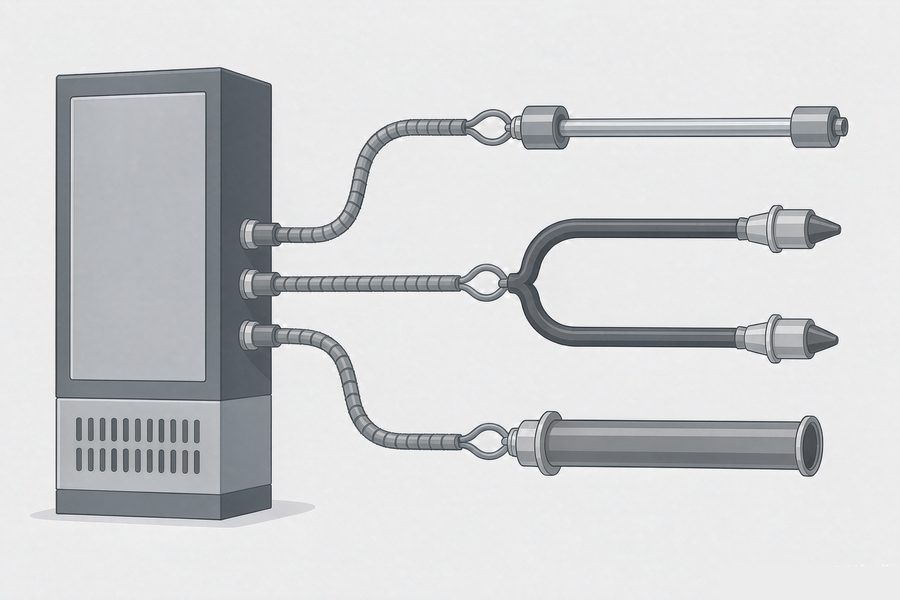
How do the three heating elements differ?
Bottom line: all three can be regulated by an SCR power controller, but their resistance–temperature curves and ageing behaviour differ, so their start-up strategy and closed-loop mode differ too.
The common point is that all three are resistive loads: heating power is decided by voltage, current and resistance together. Once that is understood, "can one controller do all three" becomes "can this controller's parameters cover three resistance curves."
| Comparison item | Electric heater tube | MoSi2 rod | SiC rod |
|---|---|---|---|
| Heating element | Ni-Cr wire in MgO-filled metal tube | Molybdenum disilicide (MoSi2) | Silicon carbide (SiC) |
| Resistance vs temperature | Small change, near constant | Low cold resistance, rises sharply with temperature | Non-linear, large low/high-temperature difference |
| Cold start | Inrush controllable | Cold current clearly high, needs current limiting | Start current from resistance–temperature data |
| Ageing | Resistance barely changes | Resistance drifts slowly | Resistance keeps rising after long high-temp use |
| Phases | Single or three phase | Single or three phase by furnace type | Single or three phase by furnace type |
| Recommended firing | Zero-cross, phase-angle for precise control | Phase-angle or phase-angle + zero-cross | Phase-angle with constant-power loop |
| Recommended loop | Constant voltage or power | Constant current start, then constant power or temperature | Constant power, with voltage/current limits as bounds |
| Sizing focus | Margin on rated current | Check start-current ratio and current-limit curve | Enough voltage headroom for ageing compensation |
Which firing mode fits which load: zero-cross or phase-angle?
Bottom line: for heater tubes with large thermal inertia and stable resistance, prefer zero-cross; for MoSi2 and SiC with large impedance variation and a need for fast regulation, prefer phase-angle or phase-angle plus zero-cross. These output modes are parameter options in the same unit, not different models.
| Output mode | How it works | Best-fit load | Feature |
|---|---|---|---|
| Zero-cross fixed-cycle | Switches whole cycles at voltage zero-cross, varies on/off ratio within a fixed period | High-inertia heater tubes, resistance wire | Complete waveform, low harmonics |
| Zero-cross variable-cycle | Adjusts on/off ratio in real time by deviation | Same as above, when tighter temperature response is needed | Smoother regulation |
| Phase-angle | Changes thyristor firing angle to continuously regulate output voltage | MoSi2 and SiC with large impedance variation, fast regulation | Continuous, harmonics rise at deep phase-angle |
| Phase-angle + zero-cross | Phase-angle current limiting at start, then zero-cross in steady state | Loads with large cold/hot impedance gap or obvious inrush | Start control and steady running combined |
One point must be stated clearly: KULUN controllers' constant-voltage, constant-current and constant-power closed-loop modes are also effective under zero-cross firing — zero-cross is not open-loop on/off. Stable constant-power regulation under zero-cross is exactly the technical basis that lets one controller cover all three loads.
Why can one controller cover all three loads?
Bottom line: firing mode, closed-loop mode and current/voltage limits are all online-editable parameters in KULUN all-digital controllers, not hardware wired at the factory. When the load changes, edit the parameters to match the new element — no equipment swap needed.
- Output modes integrated: phase-angle, zero-cross fixed-cycle and zero-cross variable-cycle share one main control unit; switch from the menu. ST200, APR3 and APR3L are consistent here.
- Loop and limit combined: open-loop, constant-current, constant-voltage or constant-power — any of them; constant-current-with-voltage-limit and constant-voltage-with-current-limit act as mutual protection bounds, and the current limit and voltage ceiling are field-settable.
- Flexible setpoint and comms: analog setpoint, keypad digital setpoint or communication setpoint; parameters can be pushed in bulk from a host system; communication options include Modbus RTU/TCP, Profibus and Profinet by model.
| Load | Firing mode | Closed-loop mode | Start strategy | Voltage ceiling setting |
|---|---|---|---|---|
| Electric heater tube | Zero-cross fixed/variable, phase-angle for precise control | Constant voltage or power | Normal soft start | By element rated voltage |
| MoSi2 rod | Phase-angle or phase-angle + zero-cross | Constant current start, then constant power | Current-limited start from cold data | Cover hot-stage required voltage |
| SiC rod | Phase-angle | Constant power | Current limit from resistance–temperature data | Enough headroom for ageing compensation |
How to choose among ST200, APR3, APR3L and TTPR?
Bottom line: first pick the series by phase count, then the rating by current; firing and loop parameters are all set online and do not affect selection. The four series share one control core; the main differences are phase count, current rating and voltage range.
| Model | Phase and main circuit | Output current | Output mode | Closed-loop mode | Typical load |
|---|---|---|---|---|---|
| ST200 | Single-phase AC110–440 V, 45–65 Hz | AC 10–1500 A | Phase-angle, zero-cross fixed/variable | CV, CC or CP, any | Single-phase resistive loads: SiC, MoSi2, resistance wire |
| APR3 | Three-phase AC260–440 V, 40–65 Hz | AC 10–3000 A | Phase-angle, zero-cross fixed/variable | CV, CC or CP, any | MoSi2 / SiC heating in industrial, diffusion and sintering furnaces |
| APR3L | Three-phase AC110–690 V, 45–65 Hz | AC 10–3000 A | Phase-angle, zero-cross fixed/variable | CV, CC or CP, any | Higher-voltage three-phase high-temperature heating circuits |
| TTPR | Three-phase AC260–440 V, 40–65 Hz | 25–3000 A | Zero-cross, phase-angle, phase-angle + zero-cross | CV, CC or CP | Annealing, sintering, glass tank furnaces; SiC and MoSi2 heating |
The selection sequence follows three steps:
- Filter by phase: single-phase supply or single-zone circuit → ST200; three-phase circuit → choose among APR3, APR3L and TTPR.
- Rating by current: take the load's maximum operating current plus margin, then match each series' current coverage.
- Parameters by duty: MoSi2 → current-limited start; SiC → constant power with voltage headroom; heater tube → zero-cross or phase-angle by thermal inertia.
What must be re-checked when switching loads on the same controller?
Bottom line: being able to reuse the hardware does not mean copying the old parameters. Before swapping elements, recalculate at least voltage, current and firing mode, and re-set the protection thresholds.
- Voltage range: as SiC ages its resistance rises, so maintaining the same power needs a higher output voltage — keep enough headroom on the voltage ceiling.
- Maximum current: calculate start current from the new element's cold data; check the current limit, soft-start slope and fast-fuse match.
- Protection thresholds: re-set the load-open and load-ageing protection current thresholds for the new element.
- Series / parallel banks: keep resistances in one group close; when one rod breaks, current redistributes among the rest, so current-unbalance or broken-rod detection is needed.
FAQ
Must a MoSi2 heater use a phase-angle controller?
Not mandatory, but phase-angle or phase-angle plus zero-cross is recommended in most cases. MoSi2 has low cold resistance that rises sharply with temperature, so the start stage needs current limiting and the running stage needs fast regulation; phase-angle control covers the whole working range more easily. Furnaces with larger thermal inertia can also use zero-cross — KULUN controllers' constant-voltage, constant-current and constant-power loops remain effective under zero-cross. The final basis is the element maker's cold-state and hot-state resistance data.
Zero-cross or phase-angle for electric heater tubes?
Prefer zero-cross. A heater tube's Ni-Cr wire has small resistance variation with temperature and large thermal inertia, so zero-cross fixed-cycle or variable-cycle gives a complete waveform and low harmonics; switch to phase-angle only when precise temperature control or fast process response is required. The same KULUN controller switches between the two by editing parameters online — no hardware change.
After replacing a batch of new SiC rods, do I need a new controller?
Usually not, but re-set the parameters. Ageing raises SiC resistance, so after a rod change re-check the voltage ceiling, current limit and closed-loop mode; KULUN controllers' firing mode, constant-current-with-voltage-limit and constant-voltage-with-current-limit are all online parameters, edited directly. Only when the voltage ceiling cannot cover the new rods' duty, or the current rating no longer matches, is a different specification needed.
What do constant-current-with-voltage-limit and constant-voltage-with-current-limit mean?
These are two protection bounds inside one controller. Constant-current mode uses output current as feedback and stabilises current, while setting a voltage ceiling against over-voltage; constant-voltage mode uses output voltage as feedback and stabilises voltage, while setting a current ceiling against over-current. In normal operation the target loop runs; once the other quantity hits its ceiling, the unit automatically switches to limit mode — the two bounds protect each other.
How do the four models differ, and how to choose quickly?
First choose the series by phase count, then the rating by current. Single-phase circuits → ST200 (AC 10–1500 A); three-phase standard circuits → APR3 (AC 10–3000 A) or standard TTPR (25–3000 A); three-phase circuits needing a higher main-circuit voltage class or higher performance → APR3L (AC110–690 V). The four series share essentially the same firing modes, closed-loop modes and communication interfaces; switching loads only needs online parameter edits.
Timeliness note
This article is compiled from Sichuan KULUN Electric's product technical data and published website articles of November 2026, for the preliminary matching of electric heater tubes, MoSi2 rods and SiC rods and other resistive heating loads. The menu paths, parameter ranges and wiring of specific models must follow the unit's manual and the project technical agreement.