

MoSi2 (silicon molybdenum) rods are widely used in high-temperature industrial furnaces, resistance furnaces, and sintering equipment. Their cold-state resistance is low, rising gradually with temperature, and they usually run continuously for long periods. So the heating power supply must not only regulate 0–100% power, but also balance power factor, harmonics, conversion efficiency, reliability, and long-term stability.
This article compares three common options — traditional thyristor (SCR) phase control, layered SCR control, and IGBT DC regulation — and gives selection thinking for different application conditions.
1. Why Does MoSi2 Heating Demand More from Power Control?
1.1 Large cold-to-hot resistance change
MoSi2 rods have low cold-state resistance that rises as temperature increases. Across the whole heat-up process, the working range of load current and voltage changes noticeably, so the heating supply needs a wide regulation range and good dynamic adaptability.
1.2 High working temperature
MoSi2 rods mainly serve high-temperature heating, placing high demands on the stability and reliability of the power-control system.
1.3 Usually long continuous operation
Industrial furnaces often run continuously for long periods, so beyond reaching rated power, device thermal stress, harmonics, power factor, conversion efficiency, and maintenance difficulty all matter.
2. Option 1: Traditional SCR Phase Control
Traditional SCR phase control is the longest-used option in industrial electric heating. Typical structure: AC 380 V → SCR power controller → line-frequency transformer → MoSi2 rods.
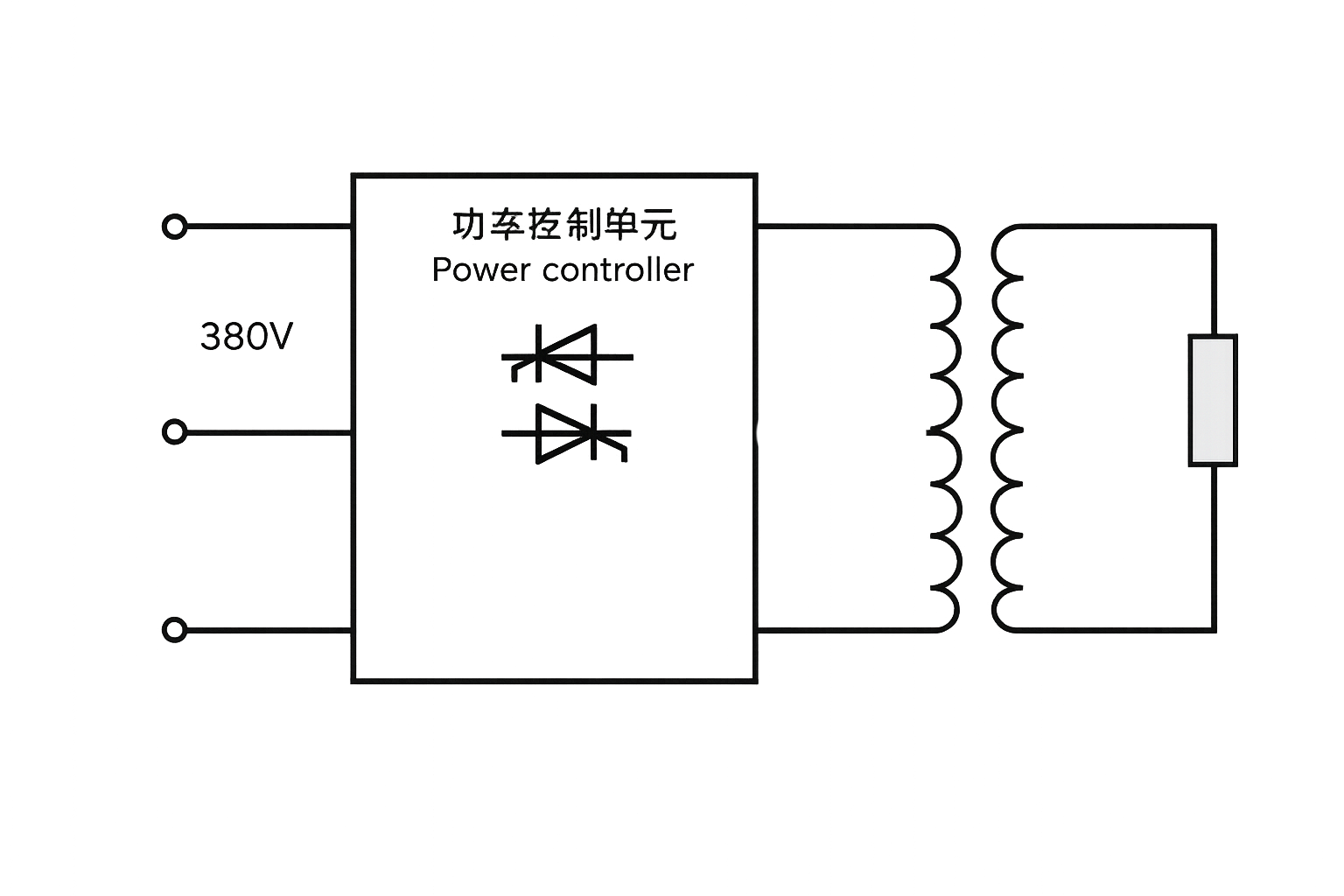
Traditional SCR phase-control option: the SCR power controller regulates the primary input of a line-frequency transformer.
How it works
The SCR power controller phase-regulates the AC voltage by changing the thyristor firing angle α. Varying the conduction angle continuously adjusts the transformer primary input voltage, thereby controlling MoSi2 heating power.
Main characteristics
- Mature control scheme with rich field experience;
- Relatively simple system structure;
- High conversion efficiency;
- Highly reliable thyristor power devices.
Note: at large firing angles (deep regulation), power factor falls while current-waveform distortion and harmonics rise. High-power systems sometimes need reactive compensation or harmonic mitigation.
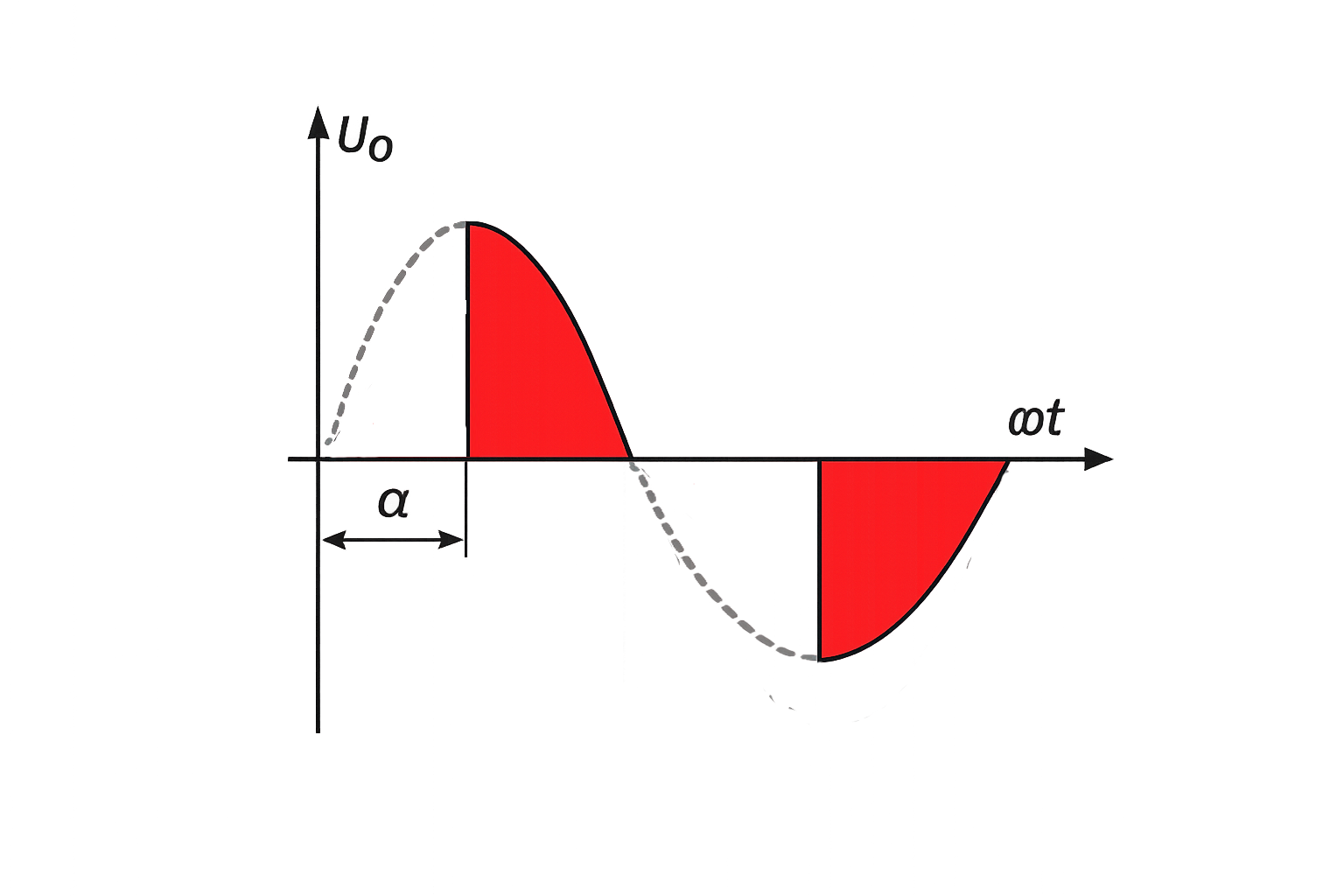
Phase-control waveform: as the firing angle grows, the AC wave is cut more deeply.
3. Option 2: Layered SCR Control
Layered SCR control can be seen as a further optimization of traditional SCR regulation. The idea: combine multiple transformer taps with multiple thyristor groups, reducing the time the system spends in deep phase-control states.
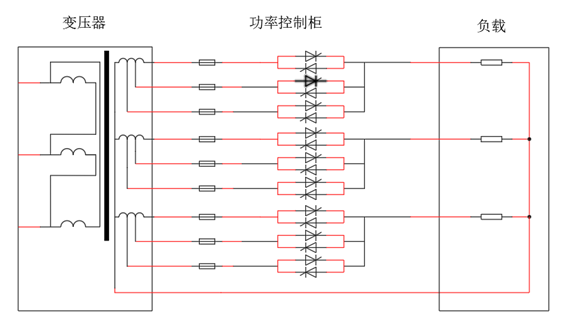
Layered SCR control: multiple thyristor groups cooperate with transformer taps for tiered output.
How does layered control work?
During heating, one or two thyristor groups run fully conducting while another group performs phase regulation. The power controller automatically switches tap combinations according to the target output, keeping regulation continuous.
Main characteristics
- Higher power factor: tap combinations provide a base voltage close to target, reducing deep phase-control regions.
- Lower harmonics: less waveform cutting than pure large-angle phase control.
- Keeps SCR reliability: the main power devices remain thyristors.
- Larger system: multi-tap transformers and their power circuits add structural complexity and cost.
4. Option 3: IGBT DC Regulation
IGBT DC regulation follows a different technical route. Typical structure: three-phase AC → rectification → DC bus → IGBT high-frequency inversion → high-frequency transformer → output rectification/filtering → MoSi2 rods.
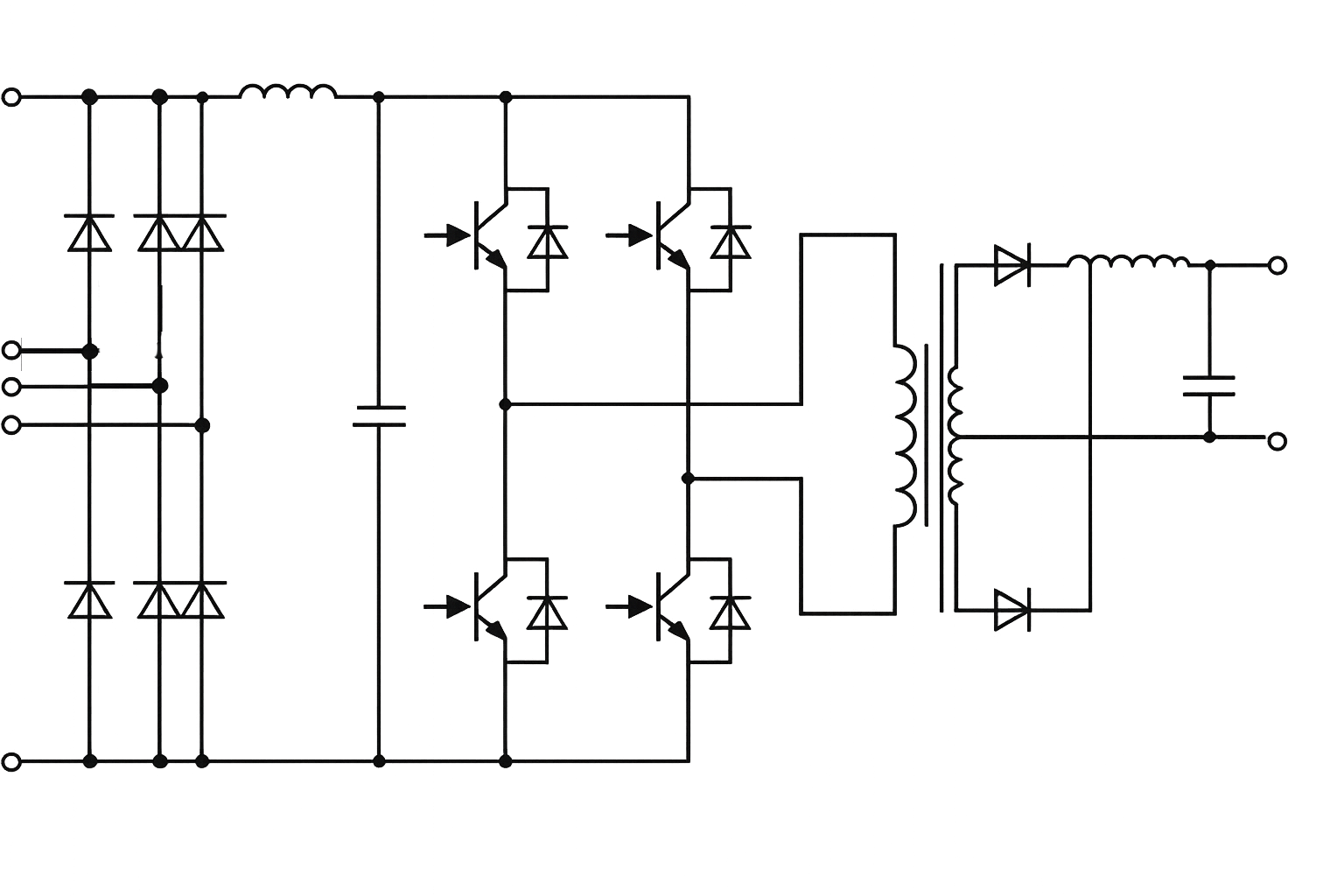
IGBT DC regulation: rectifier, DC bus, high-frequency inverter, high-frequency transformer, and output rectification/filtering.
Main characteristics
- Higher power factor: the front-end rectifier and DC-bus structure favors good PF performance.
- Smaller equipment: high-frequency transformers are far smaller than 50 Hz line-frequency units.
- Flexible control: high-frequency PWM enables voltage, current, or power closed loops.
- Higher complexity: includes rectification, DC bus, inversion, HF transformer, secondary rectification, and filtering.
- EMI and cooling need attention: high-frequency switching brings EMC, dv/dt, wiring, and cooling design requirements.
5. How Do the Three Options Differ?
| Item | Traditional SCR | Layered SCR | IGBT DC |
|---|---|---|---|
| Conversion efficiency | High | High | Relatively high |
| Power factor | Low | High | High |
| Harmonics | High | Low | Relatively low |
| Reliability | High | High | Relatively high |
| Equipment size | Relatively large | Large | Small |
| EMI | Small | Small | Large |
| Control complexity | Relatively low | Medium | Relatively high |
| Main power devices | SCR | SCR | IGBT |
| Transformer | Line-frequency | Multi-tap line-frequency | High-frequency |
6. How Do Traditional and Layered Control Differ in Harmonics and PF?
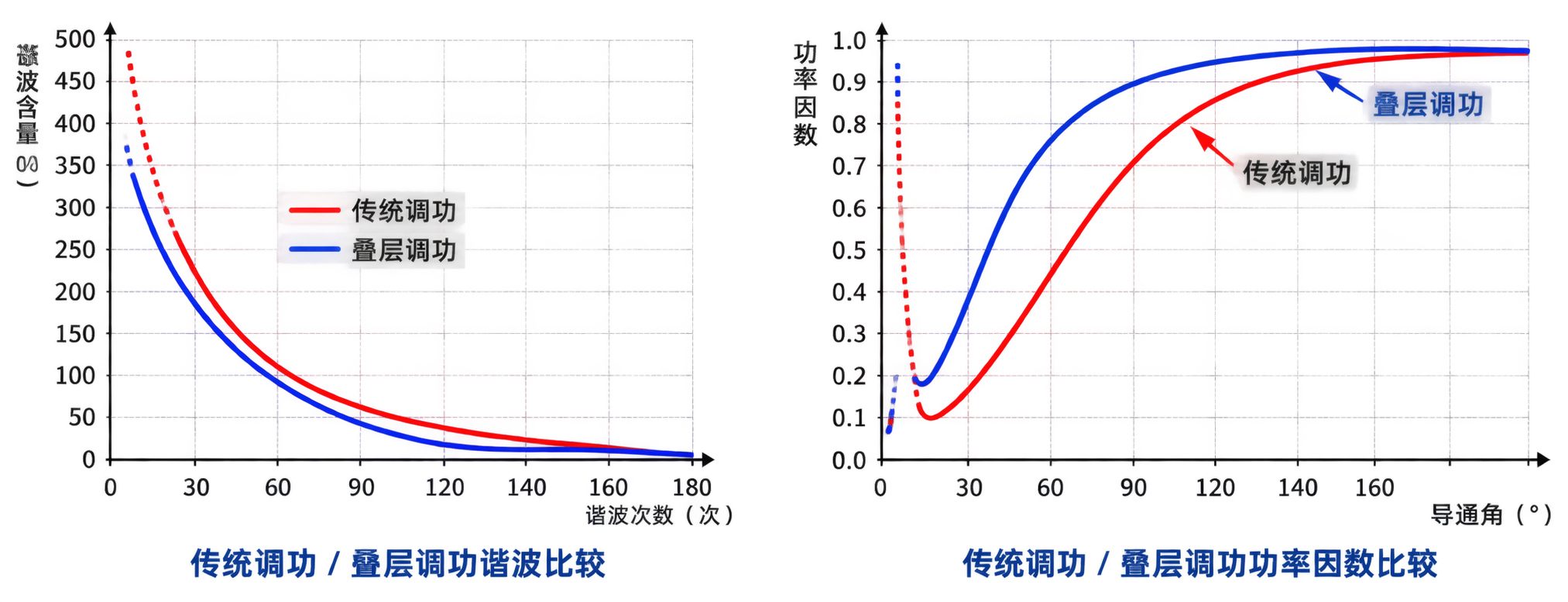
Harmonic content and power factor compared: layered control holds higher PF and lower harmonics across a wider firing-angle range.
When traditional phase control lowers output, it must increase the firing angle, cutting the sine wave more deeply — harmonics rise and power factor falls.
Layered control first uses transformer tap combinations to obtain a base voltage close to the target, then applies partial phase regulation for fine control. This reduces the time thyristors spend in deep phase-control states, helping lower harmonics and keep power factor high.
7. How to Choose Among the Three?
No single option suits every MoSi2 heating installation. Actual selection should consider per-zone power, number of zones, MoSi2 working voltage, cold-start current, transformer capacity, grid harmonic requirements, power-factor requirements, installation space, cooling, long-term reliability, and budget.
- Traditional SCR: prioritize maturity, simplicity, and long-term reliability, with modest harmonic/PF requirements.
- Layered SCR: suits high-power high-temperature furnaces that want better PF and harmonics while keeping SCR reliability.
- IGBT DC: for projects valuing size, power density, and digital closed-loop control, with corresponding EMI and cooling design capability.
8. Selection Example
For an industrial furnace with multiple MoSi2 zones, each of considerable power, running continuously long-term:
- Option A: SCR controller + line-frequency transformer — for projects prioritizing mature structure, cost, and reliability.
- Option B: layered SCR + multi-tap transformer — for projects wanting improved harmonics and PF while keeping SCR reliability.
- Option C: IGBT DC power supply — for projects with higher demands on size, digital control, and power density.
The final option still requires calculation and technical confirmation against MoSi2 rated voltage/current, cold/hot resistance change, and overall supply capacity.
9. FAQ
Can MoSi2 rods use an SCR controller directly?
Yes, but usually with a suitable transformer and regulation range configured for the rods’ rated voltage, current, and cold/hot resistance change — plus soft-start, current-limiting, and protection settings.
Why is MoSi2 cold-start current relatively high?
Cold-state resistance is low, so at the same voltage the cold current is clearly higher than at high temperature. Heating supplies must be designed with soft start, current limiting, and current protection.
Why does SCR control affect power factor?
In phase control, thyristors delay conduction and cut the AC waveform. As the firing angle grows, current-waveform distortion increases and power factor falls.
What is layered control?
Layered control combines multiple transformer taps and thyristor groups for output voltage, using only some SCRs for fine phase regulation — reducing deep phase-control operation.
Is layered control always better than traditional SCR?
Not necessarily. Layered designs usually show better PF and harmonics, but the transformer and control structure are more complex, and size and cost may rise.
What are the advantages of an IGBT DC supply?
Higher power factor, smaller size, flexible control, and easy digital closed loops — alongside higher system complexity and stricter EMC/cooling requirements.
10. Conclusion
Choosing a MoSi2 heating supply is essentially a balance among reliability, power factor, harmonics, efficiency, size, control performance, and cost.
In short: traditional SCR — mature and reliable; layered SCR — SCR reliability plus better PF and harmonics; IGBT DC — compact and flexible, but more complex.
For high-power MoSi2 projects, don’t select a controller by rated power alone — design the whole system around cold/hot resistance, working voltage and current, supply transformer capacity, zone count, and grid-quality requirements.
Related reading: SCR vs IGBT power supplies, How to choose an SCR power controller.