

For SiC and MoSi2 heating, start with resistance changes, then check voltage and current. MoSi2 needs cold-start current control; SiC needs voltage headroom for ageing. Size the SCR controller and transformer for each heating zone.
This guide covers thyristor (SCR) power controllers and heating transformers. Use element manufacturer data and the project technical agreement for final sizing.
1. How do SiC and MoSi2 differ?
| Item | MoSi2 | SiC |
|---|---|---|
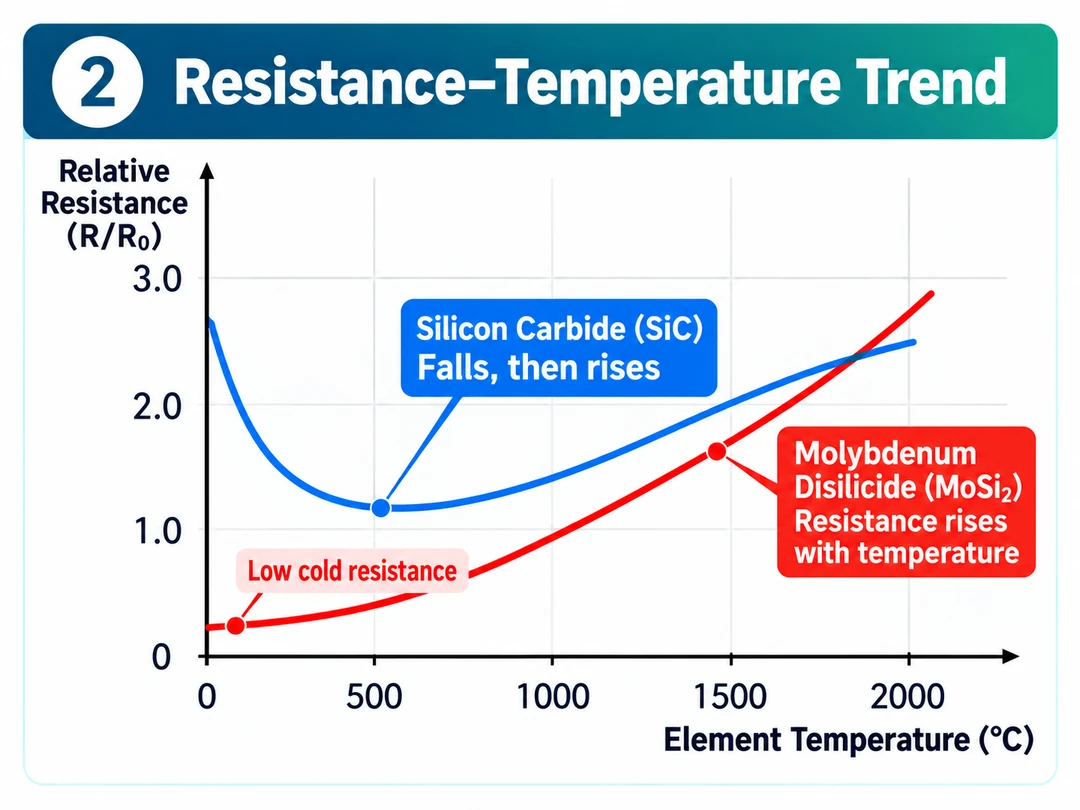
| Resistance | Low when cold; rises with temperature | Changes with temperature and use; may rise with ageing |
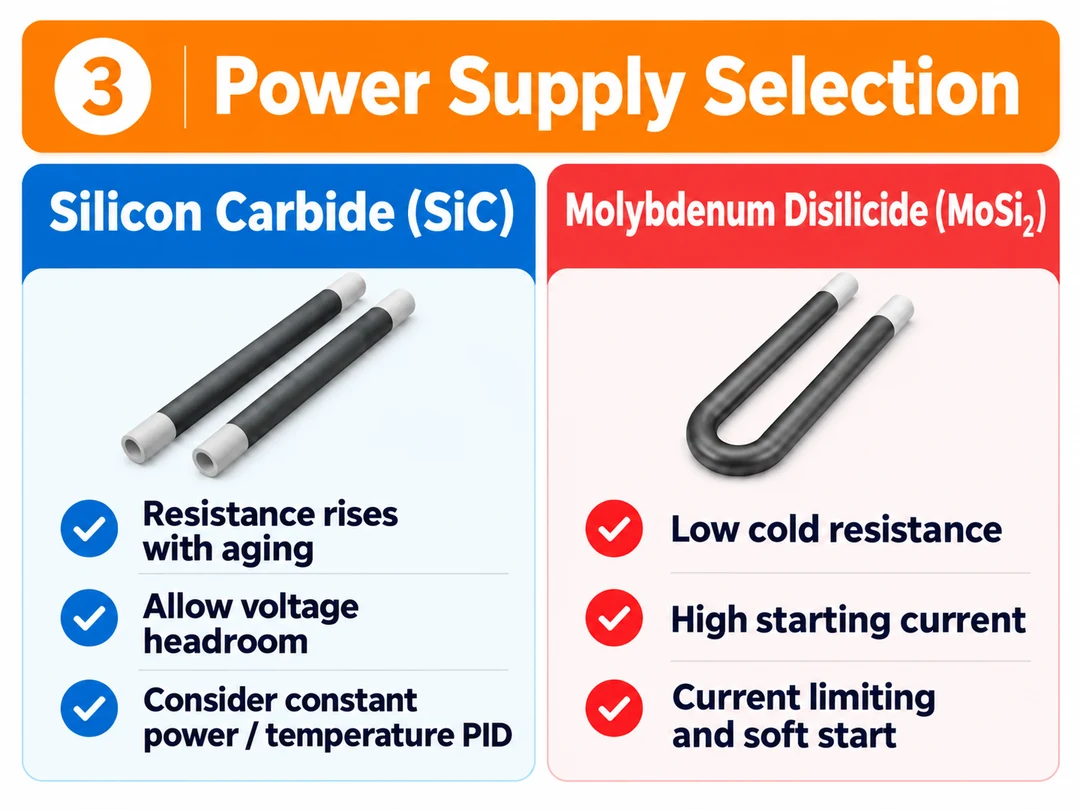
| Main risk | Excessive cold-start current | Insufficient voltage and reduced power as elements age |
| Sizing focus | Current limiting, soft start and protection | Voltage range, transformer taps and available power |
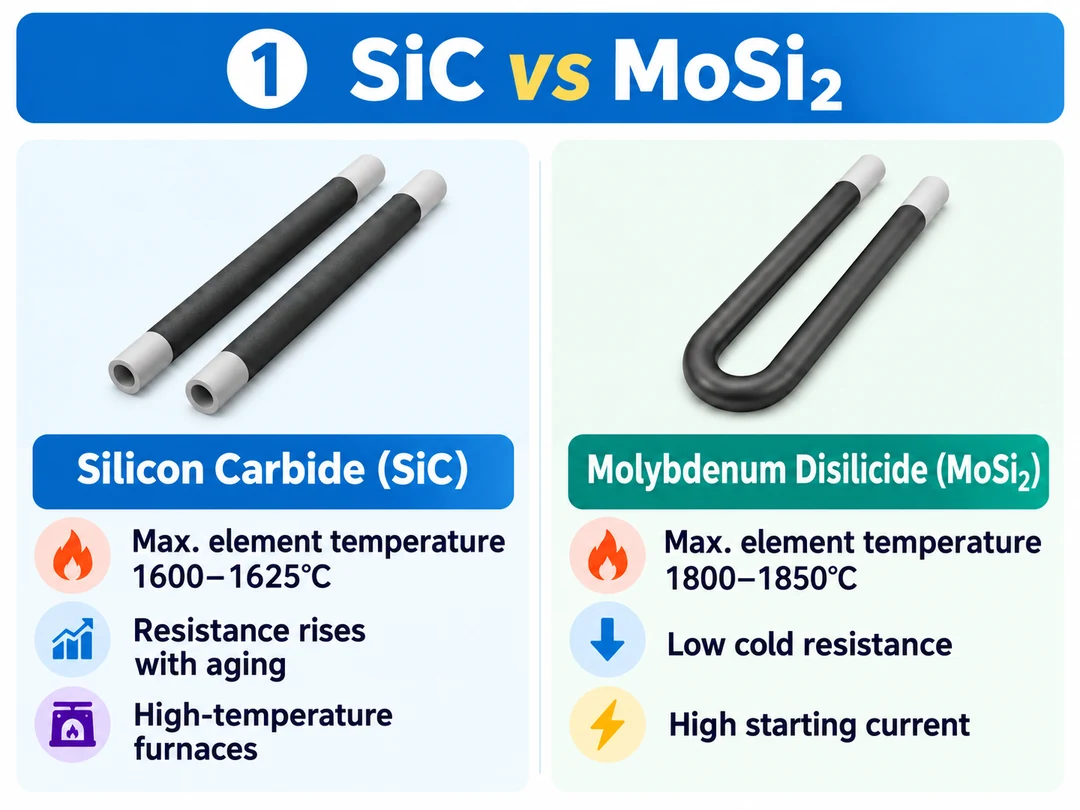
MoSi2: At the same voltage, low cold resistance produces higher current. Limit current at startup, then increase power according to the process.
SiC: Higher resistance requires more voltage to maintain the same power. Check voltage headroom against the expected service-stage data.
2. How do you check voltage and current?
For one approximately resistive load group at a specified operating condition:
- Current: I = U / R
- Power: P = U² / R
- Required voltage: U = √(P × R)
P: power in W; U: RMS voltage across the load in V; I: RMS current in A; R: equivalent resistance at that condition in Ω. Calculate three-phase total power separately for the actual connection.
Check each stage: cold-start current, hot-state power and the voltage limit after ageing. Keep the electrical data for these conditions separate.
3. How do you size the transformer?
A transformer may match the supply to the element operating voltage. A common arrangement is AC supply → SCR controller → power-frequency transformer → heating elements.
- Secondary voltage: cover operating voltage and later adjustment needs.
- Secondary current: check maximum zone current and simultaneous operation.
- Rating and taps: account for adjustment range, losses and continuous duty.
- Primary circuit: check magnetising inrush, firing method, current limiting and protection.
Remember: transformer rating is in kVA; heating power is in kW. The figures are not interchangeable. A controller on the primary side must be sized for primary current and transformer circuit characteristics.
4. Which control method fits?
| Requirement | Control approach | Check |
|---|---|---|
| Reduce startup current | Current limiting and soft start | Cold-state data, ramp rate and fast-fuse coordination |
| Stabilise heating power | Evaluate constant-power control | Model capability, feedback and voltage/current limits |
| Follow a temperature profile | Temperature PID with power control | Temperature sensing, command signal and interlocks |
| Control a transformer load | Evaluate phase-angle control | Inrush, harmonics and power factor |
Constant-power and temperature control address different targets. Choose their combination for startup, heating and soaking according to the process, rather than the element name alone.
5. What data should you provide?
- Elements: type, model, quantity and series/parallel or star/delta connection.
- Resistance: manufacturer data for cold, hot and expected service stages.
- Zones: power, voltage, current and zones operating simultaneously.
- Supply: phase configuration, input voltage and existing transformer data.
- Control: temperature profile, current limits, signals, communications and interlocks.
- Environment: duty, cabinet temperature, cooling, dust and corrosive conditions.
Sizing order: elements and connection → stage-specific electrical data → zone voltage/current → transformer → controller, protection and cooling.
6. Which sizing mistakes should you avoid?
- Only specifying total power: misses zone loads, connections and maximum current.
- Only checking hot-state data: misses cold-start current and ageing.
- Only choosing a larger controller: cannot solve insufficient voltage or replace current limiting and protection.
- Ignoring the transformer primary: resistive elements do not make the whole circuit purely resistive.
FAQ
Q: Does MoSi2 always need constant-power control?
A: No. Check current-limited startup and protection first. Then assess constant-power, constant-current and temperature control against the process requirements.
Q: Does slower SiC heating mean a controller fault?
A: Check actual voltage/current, element resistance, connections, transformer taps and the command signal. Ageing and insufficient voltage can also reduce power.
Q: Do heating elements always need a transformer?
A: No. Decide from the assembled load's operating voltage/current and the available supply.
Q: Is total power enough for final sizing?
A: No. Provide zone electrical data, connections, cold/hot characteristics, supply, control and environmental conditions.
Source and scope
Compiled from technical material available to Sichuan Kulun Electric Co., Ltd. as of October 2026. This guide supports initial high-temperature heating circuit selection. Illustrations are educational; element data, resistance curves and the final design must follow manufacturer documentation and the project technical agreement.
Related Technical Knowledge
Why Do SiC and MoSi2 Heating Need Constant-power SCR Controllers?
How to Size an SCR Power Controller by Load Calculation
Application Case
APR3 & ST200 SCR Power Controllers in Lithium Battery Sintering Pusher Kilns