

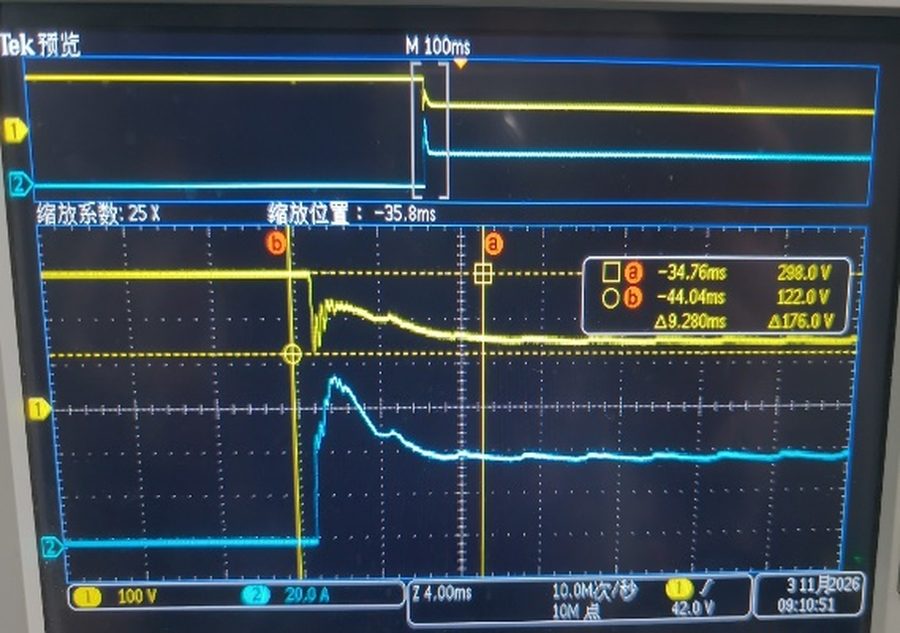
Conclusion: a KULUN 200 V/300 A constant-current IGBT DC power supply settles from no load to load in 6.60–9.28 ms across seven current setpoints (30%–100%), averaging 7.58 ms, with every group under 10 ms. The test used a resistive dummy load to reproduce the arc-striking voltage drop of a plasma power supply; this article gives the setup, the seven measured results and the method used to read them.
How was the no-load to load test carried out?
The aim was to reproduce what happens when a plasma power supply strikes an arc: the output first sits at open-circuit voltage, then a load is switched in and the voltage collapses to the operating point. The 200 V/300 A unit ran at no load at about 291 V. A circuit breaker then closed the resistive dummy load (18 series × 2 parallel plus 17 series × 2 parallel). Channel 1 (yellow) recorded output voltage and channel 2 (blue) recorded output current, and the time for the voltage to settle was read from the scope. The current setpoint was stepped from 100% down to 30% in seven groups, one record per group.
| Item | Value in this test |
|---|---|
| Model | 200 V/300 A, constant-current control |
| Load | Resistive dummy load, 18S2P plus 17S2P |
| Open-circuit voltage | Approx. 291 V |
| Steady state at 100% setpoint | Approx. 147 V / 300 A |
| Hardware / software version | DC_MainBoard_V4.01 / DCA_V1.03 |
| Scope channels | CH1 yellow = output voltage, CH2 blue = output current |
| Load switching | Breaker closes the load line, simulating a sudden load step |
What were the settling times at each current setpoint?
| Current setpoint | Steady-state voltage | Settling time | Record note |
|---|---|---|---|
| 100% | 147 V | 9.28 ms | Dipped below steady value |
| 90% | — | 7.98 ms | Dipped below steady value |
| 80% | — | 7.60 ms | Reached the settling threshold |
| 70% | 106 V | 7.66 ms | — |
| 60% | 92 V | 6.84 ms | — |
| 50% | — | 7.08 ms | — |
| 30% | — | 6.60 ms | — |
The slowest group was 9.28 ms at the 100% setpoint and the fastest 6.60 ms at 30%. The mean is 7.58 ms and the median 7.60 ms. Steady-state voltage is listed only where the original record states it; groups that were left blank are marked with a dash rather than estimated.
What do these numbers mean for plasma arc striking?
- All seven groups settled within 10 ms, which matches the original note that the output stabilises within 10 ms.
- Settling time shortens as the setpoint drops: 9.28 ms at 100% against 6.60 ms at 30%.
- At 100% and 90% the voltage dipped below its steady value before recovering, and at 80% it reached the threshold, so a short dynamic recovery belongs to a high-setpoint load step.
For arc striking, a 291 V open-circuit output that reaches the operating voltage within 10 ms means the supply keeps up with the load step at the moment the arc is established instead of drifting for tens of milliseconds.
FAQ
How is the no-load to load settling time measured?
Two scope cursors are used: one at the instant the load is switched in, the other where the voltage reaches the reading point. The gap between them is the settling time. The original record keeps only text results and waveform screenshots, with no sample series, so no post-processed rise time is reported and every figure comes from a cursor reading. Groups noted as 9.4 ms and 6.8 ms in the text correspond to cursor values of 9.280 ms and 6.840 ms.
Why use a resistive dummy load instead of a real plasma load?
Closing a resistive load reproduces the electrical event, with 291 V open circuit pulled down to the operating voltage, without arc behaviour, gas pressure and electrode wear adding scatter. That makes a clean step-by-step comparison of current setpoints possible. The test characterises the dynamic response of the power supply itself rather than the arc. In the field, load-loop inductance and cable length add to the measured settling time.
Does the voltage undershoot affect plasma arc striking?
The 100% and 90% groups dipped below the steady value before recovering, and the 80% group reached the threshold. This is dynamic recovery after a load step, and the criterion is entering and holding the steady state. Allow for the dip in the instantaneous current margin of the electrode; where its depth matters, give the load-loop parameters to the manufacturer so the setpoint ramp and current limit can be checked.
What response time counts as fast for an industrial DC power supply?
There is no single scale, so compare like with like: voltage settling after a load step is not the same as current rise time, and the two give different numbers. This 200 V/300 A unit, measured on the voltage criterion, came in at 6.60–9.28 ms. Shorter settling means less risk of losing the arc or dropping current when the load changes abruptly. When comparing quotations, ask for the criterion, the load circuit and the scope sample rate.
Timeliness note
This article is based on test data measured by Sichuan Kulun Electric in November 2026 (scope time stamp 2026-11-03) on a 200 V/300 A constant-current DC power supply at hardware version DC_MainBoard_V4.01 and software version DCA_V1.03. Figures differ with power rating, control mode and load circuit. Always follow the manual and wiring diagram supplied with the unit.