

Conclusion: an SCR power controller can drive a transformer load with zero-cross firing, but only if the control mode and the start-up sequence are chosen correctly — use "zero-cross fixed-period" control combined with a magnetizing soft start, which lets the transformer build up its magnetic field smoothly within roughly 100 ms and avoids the inrush current that appears at hard energization. The "zero-cross variable-period" mode must not be used on a transformer or any other inductive load. This article explains what kind of load a transformer is, how zero-cross control works and why it improves power factor and harmonics, why the variable-period mode fails on transformers, and how to configure the load-type parameter (F120 as an example).
Many customers connect a transformer primary to a heating or furnace circuit and meet the same symptom on day one: the incoming circuit breaker trips as soon as it is switched on, and it keeps tripping every time. The problem is usually not the breaker itself, but a mismatch between the load type and the starting method. Let's start with load classification.
What Type of Load Is a Transformer? Why Does the Breaker Trip at Switch-On?
Industrial loads fall into three electrical categories: resistive, inductive and capacitive. Resistance furnaces and electric heaters are typical resistive loads. A transformer is made of copper windings and an iron core, and its coils establish a magnetic field when energized, so it is a typical inductive load. Reactors and solenoid coils behave the same way.
An inductive load has one key property: the magnetic flux cannot change abruptly. If full voltage is applied to an unloaded or lightly loaded transformer in one step — for example by closing the incoming breaker directly — the core flux has no time to build up, and a very large magnetizing inrush current appears for a few cycles, usually evaluated at several times the rated current. That is enough to trip the instantaneous protection of the breaker. This is the root cause of "the breaker trips every time the transformer is energized". There is only one real solution: give the transformer a smooth starting process in which the magnetic field builds up gradually. This process is called magnetization.
What Is Zero-Cross Control? Why Does It Improve Power Factor and Harmonics?
Zero-cross control means the thyristors turn on at the zero crossing of the supply voltage and turn off at the natural zero crossing of the current, using complete sine cycles as the switching unit: the output conducts for a while (a number of full cycles), then stays off for a while, and the power is adjusted through the ON/OFF duty ratio — a cycle-level PWM of the mains. The controller behaves like a high-speed switch that is either fully on or fully off, with every transition placed at a voltage zero crossing. When the ON/OFF cycles are distributed over a fixed period T, the scheme is called zero-cross fixed-period control.
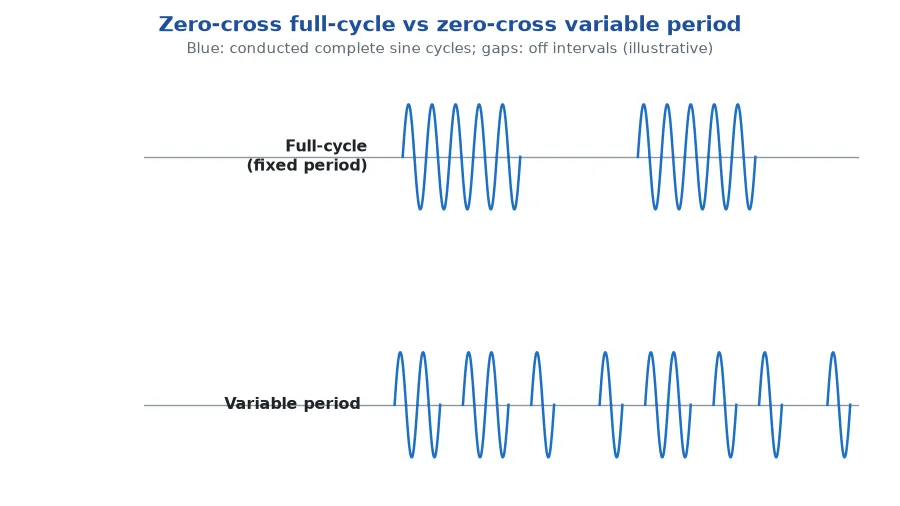
The benefit comes from the intact waveform: only complete sine cycles are conducted, so there is no phase-angle notch in the current. The harmonic content drops substantially, the displacement factor stays close to 1, and the supply-side power factor is clearly better than with phase-angle firing. The three common control modes are compared below.
| Aspect | Phase-angle firing | Zero-cross fixed period | Zero-cross variable period |
|---|---|---|---|
| Output waveform | Sine wave notched at the firing angle | Complete sine cycles, ON/OFF distributed | Complete cycles, but ON/OFF groups switch frequently |
| Harmonics | Notches generate high-order harmonics | Low harmonic content | Low harmonics, but repeated switching shocks |
| Power factor | Drops with the firing angle | Displacement factor near 1; load side can reach 0.95 or higher | Same as fixed period, but unsuitable for inductive loads |
| Suitable loads | Inductive and resistive loads | Inductive and resistive loads | Resistive loads only |
| Transformer (inductive) loads | Soft start required to limit inrush | Usable, magnetizing soft start is mandatory | Forbidden |
Why Can't Variable-Period Zero-Cross Drive a Transformer, While Full Cycles Plus Soft Start Can?
To improve resolution, the variable-period mode chops the OFF time into short fragments and switches the ON/OFF groups frequently. For an inductive load, every re-energization is close to another hard breaker closing: the magnetic field is repeatedly interrupted and rebuilt, and inrush currents and induced overvoltages keep appearing. This is why the load-type parameter of an SCR power controller carries the warning "inductive loads must not use zero-cross variable period".
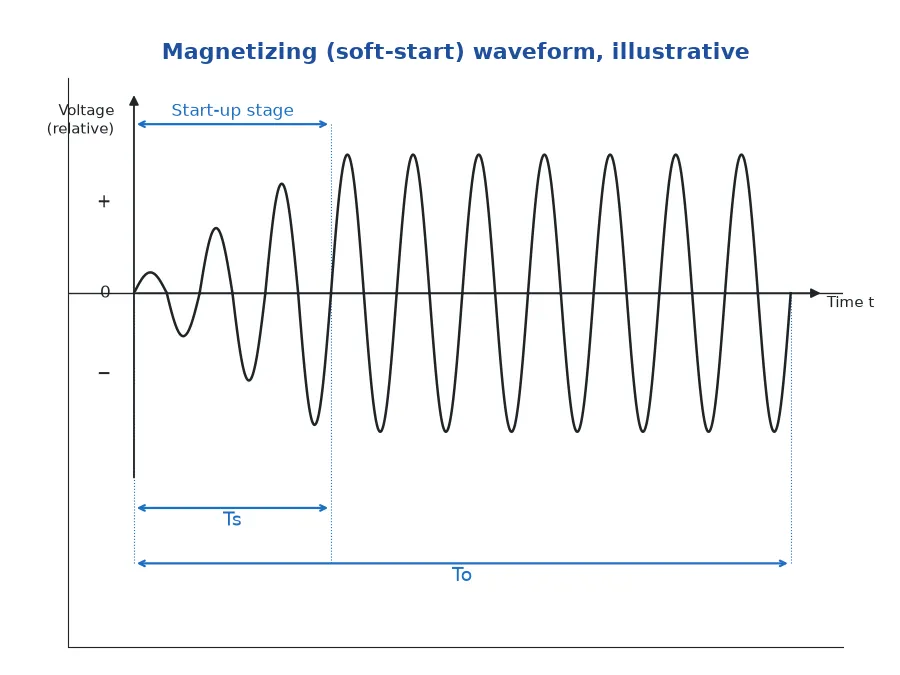
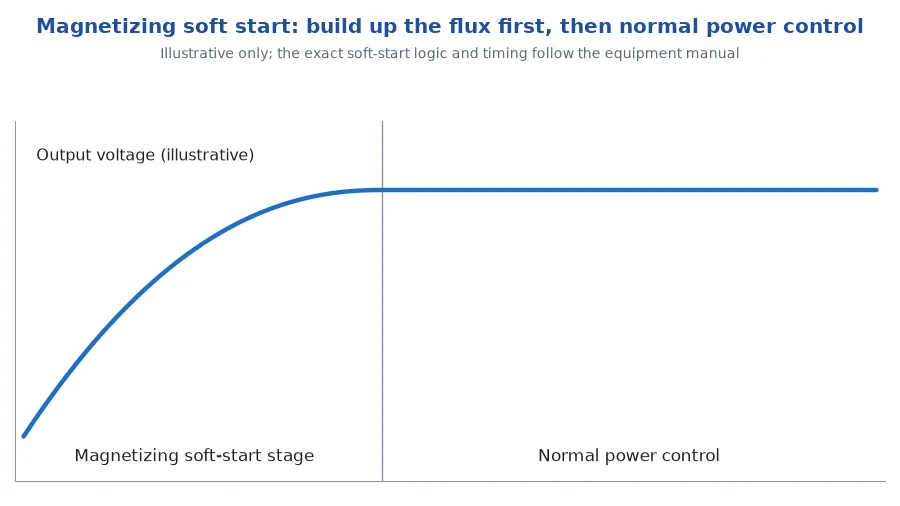
Zero-cross fixed-period control alone is not enough either: its first conducted cycle after power-up would already be full voltage, which is equivalent to a hard closing. The correct approach is a soft start plus magnetization: during the start-up stage the controller automatically ramps the output voltage up along a slope (the conduction angle opens up step by step), giving the transformer time to establish its magnetic field instead of hitting it with full voltage instantly. "Slow" here is only relative to a hard closing — the whole magnetizing process normally completes within about 100 ms, invisible to the naked eye. After the start-up stage the controller returns to normal zero-cross fixed-period control, and the transformer load enjoys the same power-factor and harmonic benefits as any resistive load.
How to Enable the Inductive-Load Mode: the Load-Type Parameter F120
The whole magnetizing sequence runs automatically; the user only needs to set the load type to "inductive" in the parameter menu. Taking the load-type parameter F120 of the APR3 series power controller as an example:
| Item | Setting |
|---|---|
| Parameter code | F120 |
| Parameter name | Load type |
| Values | 0 = resistive load; 1 = inductive load |
| Factory default | 0 (resistive) |
| Note | Inductive loads must not use the zero-cross variable-period mode |
Once the load type is set to inductive, the controller runs its magnetizing routine automatically at every power-up: the output voltage ramps up, the magnetic field builds up smoothly, and the controller then enters normal zero-cross power control. On a transformer load the power factor can reach 0.95 or higher, and the harmonic current stays within the limits of IEC and national power-quality standards.
Frequently Asked Questions
Q: What power factor can an SCR power controller achieve on a transformer load?
A: With the load type set to inductive and zero-cross fixed-period control selected, the load-side power factor can reach 0.95 or higher. Because only complete sine cycles are conducted, there is no displacement-factor loss from phase-angle notches, and the harmonic content drops accordingly, staying within the limits of the applicable power-quality standards.
Q: Why does the breaker trip when the transformer is switched on directly, but not through the power controller?
A: Closing the breaker directly applies full voltage in one step, so the core flux cannot build up and the magnetizing inrush reaches several times the rated current, tripping the instantaneous protection. With the controller set to inductive-load mode, the start-up stage runs a magnetizing soft start: the output voltage rises smoothly within about 100 ms, the field builds up gradually, the inrush stays within a safe range, and the breaker no longer trips.
Q: How do I choose between zero-cross and phase-angle firing?
A: Choose phase-angle firing for resistive loads such as resistance furnaces and heaters that need continuous fine adjustment. Choose zero-cross control for inductive loads such as transformers and reactors, or wherever supply harmonics and power factor matter. Note that for inductive loads the zero-cross mode must be the full-cycle (fixed-period) type, never the variable-period type, and the load-type parameter must be set to inductive to enable the magnetizing soft start.
Q: How long does the magnetizing soft start take, and does it affect production?
A: No. The magnetizing process normally completes within about 100 ms, invisible to the naked eye, and runs once at each power-up. After start-up the controller returns to normal power control, so there is no perceptible impact on the heating cycle.
Timeliness Statement
This article is based on general engineering practice and Sichuan Kulun Electric's SCR power controller technical documentation as of October 2026, and covers only the selection of control modes and start-up settings for transformer (inductive) loads on thyristor power controllers. Concrete solutions must follow the process requirements of the load and the technical agreement with the manufacturer. The power-factor and time figures are typical engineering magnitudes for explanation and do not constitute a measured commitment for any specific project.
Related Technical Articles
SCR Power Controller vs Power Regulator: Names and Selection
SCR Controller Current Sizing: Three-phase Load Calculation
Application Case
2x1500A SCR Power Controller for Electric Boosting in Russia