

What Is RMS Current?
When we say "220 V" or "10 A", those numbers are usually neither instantaneous peaks nor simple averages — they are a more practical figure: the RMS (effective) value.
The core meaning of RMS is simple: it tells you how large a DC current would produce the same heating effect as the AC in question.
01 | RMS: Turning Ever-changing AC into an "Equivalent DC Value"
AC constantly changes in magnitude and direction. A sinusoidal current is positive one moment and negative the next; the instantaneous current always fluctuates.
The RMS value is also called the root mean square value.
"Root mean square" sounds complicated, but break it down:
- Square the current at every instant — positives and negatives all become positive;
- Take the average;
- Take the square root.
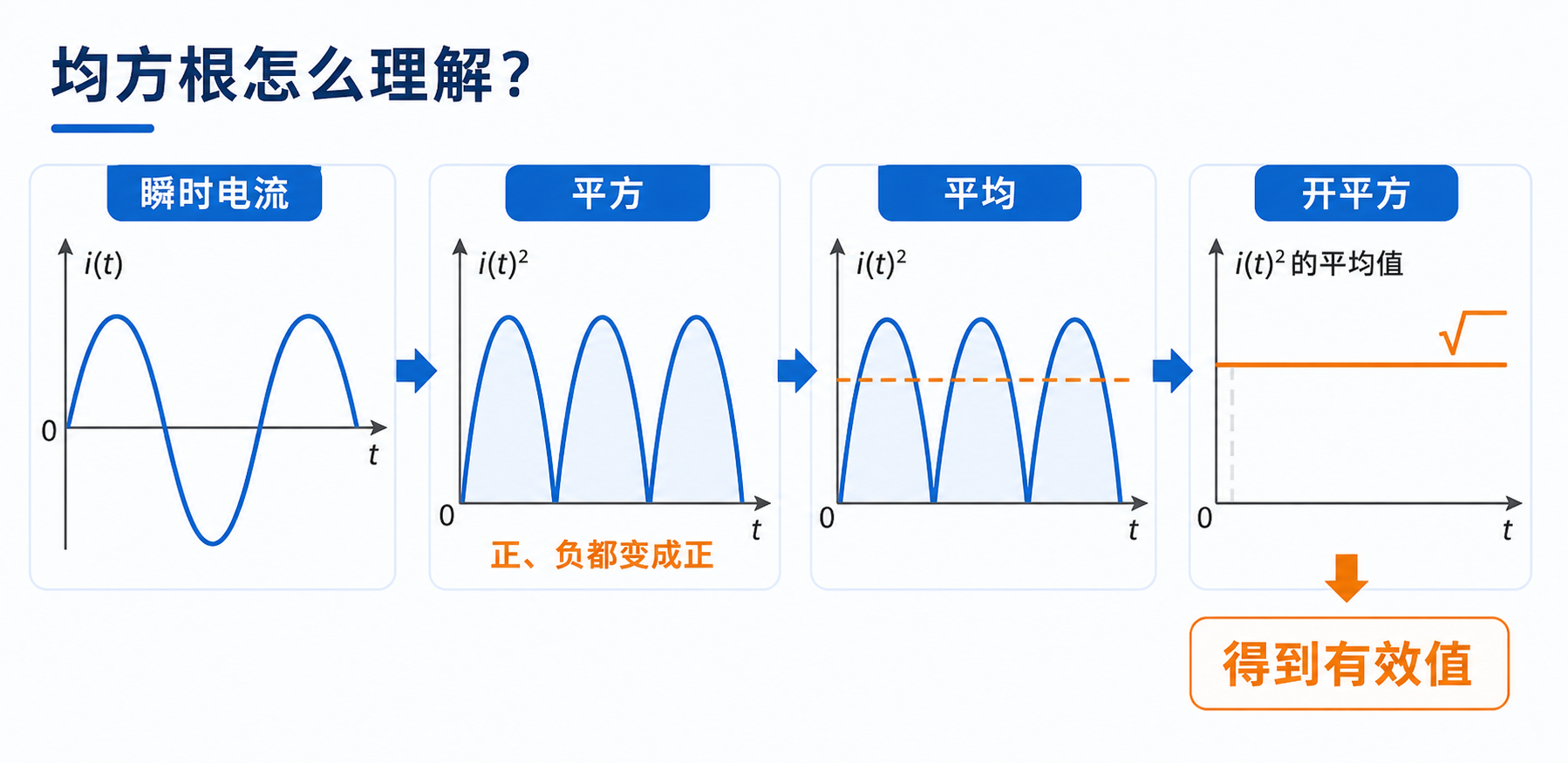
As a formula:
RMS = √(average of squared instantaneous values)
For a common sine wave:
RMS = peak ÷ √2 ≈ peak × 0.707
For example, if a sinusoidal AC has a peak current of 10 A, its RMS value is about:
10 × 0.707 = 7.07 A
That is, this AC has the same heating capability as 7.07 A of DC.
02 | RMS vs Average: What’s the Difference?
Many people mix up "RMS" and "average", but they answer different questions.
| Item | Average | RMS |
|---|---|---|
| Calculation | Add instantaneous values and average directly | Square, average, then square-root |
| Sign handling | Positive and negative cancel out | Squaring first — no cancellation |
| Sine wave over one cycle | Average is 0 | Has a real effective value |
| Main meaning | Describes overall bias | Describes work / heating capability |
Take a sine wave: the positive and negative half-cycles are symmetric, so the average over a full cycle is 0.
But that clearly doesn’t mean it carries no energy — water heaters, rice cookers, and electric stoves all heat up, proving AC keeps doing work.
So: the average can "cancel out" AC’s real energy, while RMS reflects its true working effect.
03 | Why Do Electricians and Engineers Prefer RMS?
Because whether an appliance works properly, whether a wire heats up, and whether equipment overloads all depend on the actual energy effect of current and voltage.
For resistive loads — heating wire, electric stoves, heaters:
Heating power P = I²R
Here I should be the RMS current.
Equivalently:
Heating power P = U² ÷ R
Here U should be the RMS voltage.
In other words, RMS directly determines how much electrical stress wires, components, and appliances actually bear.
04 | What Do "220 V" and "10 A" Usually Mean?
In everyday AC use, marked voltage and current values are RMS values.
- Household "220 V" means 220 V RMS voltage;
- The peak of a sinusoidal 220 V AC is about 311 V;
- An AC rated current on a nameplate, such as "10 A", usually means 10 A RMS current.
"Rated" means the values the equipment is designed for and runs on normally; in AC systems these rated voltages and currents are generally marked as RMS values.
05 | What Does RMS Mean for Heating?
Take a resistance wire:
- Feed it 5 A DC;
- Or feed it 5 A RMS AC.
Over the same time, the wire produces the same heat in both cases.
That is the most intuitive meaning of RMS:
"5 A RMS AC" does not mean "averaging only 5 A" — it means "the heating effect equals 5 A DC".
So when choosing wires, breakers, contactors, transformers, and appliances, look beyond instantaneous peaks and beyond averages — focus on RMS.
One-sentence Summary
The RMS current is the value of AC that produces the same heating effect as that amount of DC.
Computed by "root mean square", it accurately reflects AC’s working capability. The 220 V we quote daily, and the rated currents of AC equipment, are usually expressed as RMS values.