

A plating power supply is not just "enough voltage and current". Coating uniformity, adhesion, brightness, porosity, and production rhythm are all affected by output waveform and control accuracy. Selecting a plating supply should start from process requirements, then match the right power topology and control scheme.
For conventional rack and barrel plating, and for pulse plating and pulse-reverse plating with higher coating-performance demands, the selection logic differs. Below is a practical method across six dimensions: process, voltage, current, ripple, efficiency, and control.
1. Process First: Continuous DC, Pulse, or Pulse-reverse?
The process decides the output form. Conventional zinc, nickel, and copper plating mostly uses continuous DC output. For complex workpieces with deep holes and recesses, or to improve coating density, throwing power, and uniformity, consider pulse output. For eliminating dendrites, improving edge burning, and optimizing special coating properties, evaluate pulse-reverse solutions.
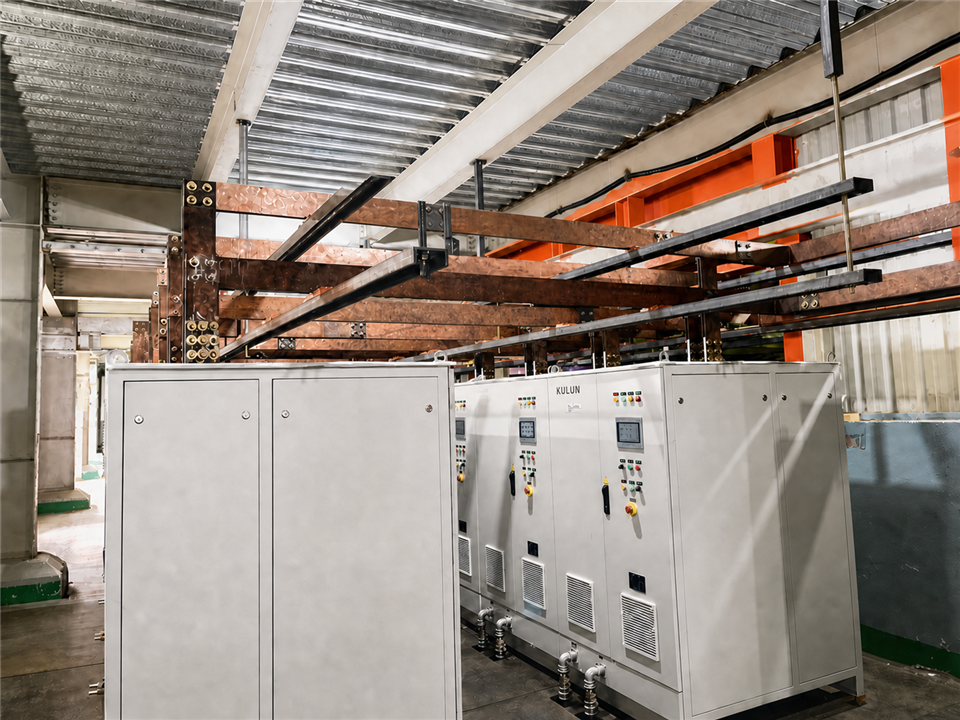
Figure: start from process requirements, balancing output parameters, energy consumption, and automation control.
| Process need | Recommended output | Focus |
|---|---|---|
| Conventional rack/barrel plating | Continuous DC | Stable output, current density, maintenance convenience |
| Complex workpieces, deep holes/recesses | Pulse DC | Pulse width, frequency, peak vs average current |
| High-demand coatings or special processes | Pulse reverse | Forward/reverse ratio, reversal response, process window |
2. Choosing the Topology: Different Supplies Solve Different Problems
- Traditional SCR rectifiers have mature structure and suit high-current, relatively stable processes;
- High-frequency switching supplies feature small size, high efficiency, and fast response — suiting lines that value energy savings, stability, and automation;
- Pulse or pulse-reverse processes need dedicated supplies with waveform generation and fast-switching capability.
- In practice, don’t judge by "maximum current" alone. Consider the rectifier’s long-term duty, load-variation range, multi-stage recipe needs, and PLC or line-management integration when fixing the power structure.
3. Voltage: Enough Process Margin, but Not Blindly Oversized
The rated voltage should cover the bath’s actual working voltage, accounting for voltage drops across cables, busbars, contacts, electrodes, and fixtures. Too low, and set current cannot be held as the load changes; too high raises cost and harms fine regulation.
Calculate the working range from bath count, anode-cathode spacing, conductor-loop drop, and process current density, reserving reasonable margin for startup, warm-up, and contact-state changes.
4. Current: Centered on Current Density, with Continuous-duty Capability
Current directly determines current density — the key parameter for deposition rate and coating quality.
Size the required current from effective plating area, loading, and the process-specified current density, considering racks, batches, and product-mix changes.
For barrel plating and other strongly fluctuating loads, pay special attention to stable output from low load to full load.
Rate the current to actual production load: avoid long-term full-load running, and avoid oversizing that makes the regulation range too coarse.
5. Ripple: The Important "Invisible Parameter" of Coating Quality
- Ripple is the AC fluctuation superimposed on DC output.
- Excessive ripple can destabilize current density, affecting surface state, thickness consistency, and repeatability.
- For conventional processes, stable, controllable low ripple is usually favorable;
- For demanding processes, discuss ripple separately from pulse parameters.
- Emphasis: pulse output is an intentional, regular process waveform;
- ripple is non-ideal fluctuation.
When choosing a pulse supply, confirm pulse frequency, duty cycle, peak current, and rise/fall edges — not just "low ripple".
6. Efficiency: About Energy, Heat, and Reliable Running
- Plating lines run long hours at high current; supply efficiency directly affects electricity cost and workshop heat load.
- High-efficiency supplies cut wasted loss, ease temperature rise, and help long-term stability.
- When assessing efficiency, also consider efficiency at typical load, cooling method, installation environment, and maintenance conditions.
- For workshops with many rectifiers installed together, coordinate distribution capacity, ventilation, and EMC requirements.
7. Control: From "Manual Adjustment" to "Repeatable Process"
- Basic applications can use local constant-voltage / constant-current control;
- Automated lines suit solutions with remote start/stop, parameter setting, status feedback, and fault alarms.
- If the process includes multi-stage current curves, pulse-parameter switching, or recipe management, confirm the supply’s communication adaptability with PLC, touch screen, or host computer.
The value of control is not just "convenient operation" — it turns proven processes into callable parameter recipes, reduces batch differences from manual adjustment, and reserves room for quality traceability and line upgrades.
8. Sichuan KULUN Electric: Matching Power Configuration to Real Plating Conditions
KULUN Electric provides rectifier, IGBT DC, SCR DC, and low-voltage high-current DC solutions based on your electrochemical process parameters.
Choosing the right plating supply is essentially matching "process requirements" with "output capability". Define the process first, then calculate voltage and current, then confirm ripple, efficiency, and control interfaces — so the equipment truly serves coating quality and stable production.