

Conclusion: "Control accuracy" on a SCR power controller or DC power supply covers three different metrics. A 2000 A setpoint that reads 1900 A on an external meter is accuracy; an output that holds within 0.1% (2 A at 2000 A) is stability; the smallest setpoint step is resolution. The supply is only an actuator in the loop, so an outer temperature loop absorbs a fixed offset but cannot absorb output drift, which propagates straight into temperature. This article explains how the three metrics differ and what to put in a technical agreement.
What does "control accuracy" actually cover?
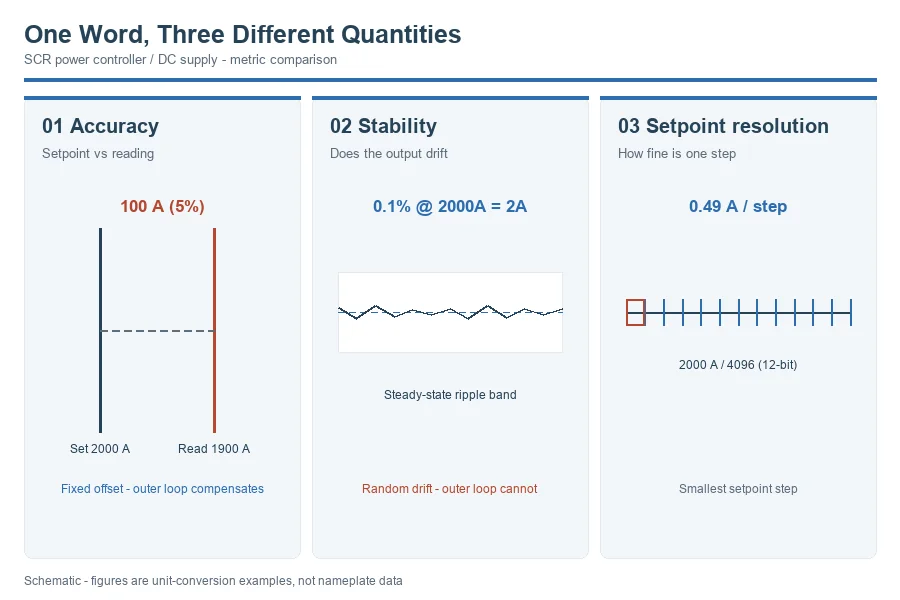
Accuracy compares the setpoint with an external meter reading. A 2000 A setpoint read as 1900 A is a 100 A error, about 5% of full scale, and answers one question: did the supply deliver the number it was given?
Stability asks whether the steady-state output drifts. When a customer says "output deviation must stay within 0.1%", the reference is not the gap to the setpoint but the band the output holds as grid voltage, load and time change. At 2000 A, 0.1% is a 2 A band.
Resolution is the smallest setpoint step. Whether the supply can accept a command of 2000.5 A depends on the bit depth and range of the setpoint channel. With a 2000 A range and a 12-bit channel, the smallest step is about 2000 ÷ 4096 ≈ 0.49 A per step; these figures are unit-conversion examples, not nameplate data.
| Metric | Compared against | Typical figure | Can the outer loop compensate? |
|---|---|---|---|
| Accuracy | Setpoint vs external meter | 2000 A vs 1900 A, a 100 A gap (5%) | Yes, one setpoint correction absorbs a fixed offset |
| Stability | Repeatability of the steady output | 0.1% of 2000 A, a 2 A band | No, random drift adds directly to heating power |
| Setpoint resolution | Smallest setpoint step | 0.49 A per step, 12-bit, 2000 A range | Not applicable, it is command granularity |
Why is a 100 A setpoint error not the main issue?
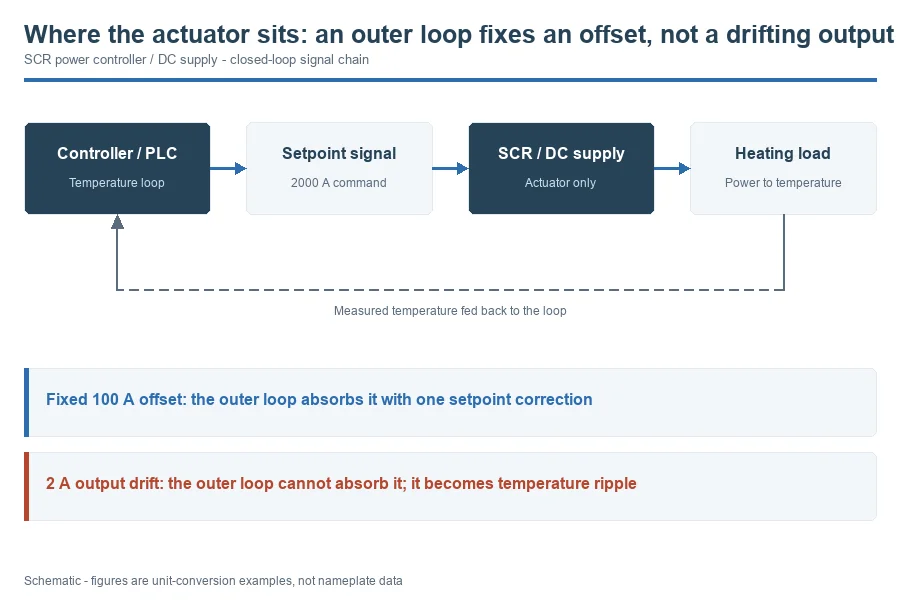
A SCR power controller or DC supply is only an actuator: it turns a command from the level above into current or power. It does not decide whether the temperature is high enough and does not calculate the process curve. That job belongs to the outer loop built from a temperature controller, a PLC or a host system.
The outer loop watches measured temperature. If the temperature is low it raises the setpoint, if it is high it pulls back. As long as the accuracy error is stable and repeatable, one setpoint correction absorbs it. A supply that is always 100 A low can still hold the final temperature.
What the loop cannot absorb is output drift. If the output is 1900 A one second and 1920 A the next, the temperature swings with it, and the loop can only chase, sometimes overshooting. Output drift from the actuator adds directly to heating power and then to temperature.
What is 0.1% of 2000 A in amps?
Percentages are easier to judge in amps. On a 2000 A range the allowed band is 2000 A × 0.1% = 2 A. Those 2 A are the disturbance the outer loop cannot remove; they travel through heating power into temperature.
Setpoint resolution is converted the same way: smallest step ≈ full range ÷ 2ⁿ, so 2000 A ÷ 4096 ≈ 0.49 A per step. The table below lines up three typical cases; all figures are unit-conversion examples.
| Case | Accuracy | Stability | Effect on temperature |
|---|---|---|---|
| Output fixed at 1900 A, drift within 2 A | 100 A offset (5%) | Pass | One setpoint correction compensates |
| Output centred on 2000 A, drift of 20 A | Pass | Fail | Temperature cycles with the output; the loop can only chase |
| Setpoint step of 5 A | Not applicable | Not applicable | Power steps appear near the target |
Which metric matters for which duty?
- Single-loop temperature holding: ask about stability first, and write long-term drift, grid variation and load switching into the conditions.
- Multi-segment process curves and cascaded zones: ask about setpoint resolution; a coarse step leaves visible stairs in the temperature curve.
- Acceptance with an external meter: only here does accuracy matter, and the measuring point, meter class and steady-state reading window must be agreed first.
Writing "accuracy ±0.1%" into a technical agreement without saying whether it means accuracy or stability leaves both sides holding valid but different data at acceptance. State the metric together with its conditions.
FAQ
A 2000 A setpoint reads 1900 A. Is the supply faulty?
Not necessarily. It is a setpoint accuracy offset of about 100 A, or 5% of full scale. If the output is stable, the outer temperature loop corrects the setpoint and the final temperature is unaffected. Check the measuring point and meter class before deciding whether calibration is needed.
What is an output deviation of 0.1% in amps?
On a 2000 A full scale, 0.1% is 2 A. It describes the steady-state ripple band, not the gap to the setpoint. Stability is a conditional figure, so the conditions should list grid variation, load steps and long-term drift.
Where does 0.49 A per step come from?
A 2000 A full scale divided by the 4096 steps of a 12-bit channel gives about 0.49 A per step, as a conversion example. The actual figure depends on the confirmed bit depth and range; if the host system cannot issue that resolution, a finer actuator does not improve control granularity.
Does supply stability affect temperature control accuracy?
Yes. Output drift from the actuator adds directly to heating power, and the outer loop can correct a fixed offset but not random drift, which becomes temperature ripple. For temperature-holding duty, specify stability first and write accuracy as a separate clause.
Timeliness note
This article is based on control-metric discussions at Sichuan Kulun Electric in November 2026. The figures 2000 A, 1900 A, 100 A, 0.1% and 2 A are conversion examples for a common customer question, and 0.49 A per step is a 12-bit example; none are nameplate data for a specific model. Values differ with power rating, setpoint channel and load circuit. Always follow the technical agreement, the manual supplied with the unit and site measurements.